
TRAVEL STORY
Following Hermes
Travels in Greece
Emily Hiestand
First published in The Very Rich Hours (Beacon Press, 1992); revised 2024
Travel Stories & Essays | Poems | Reviews
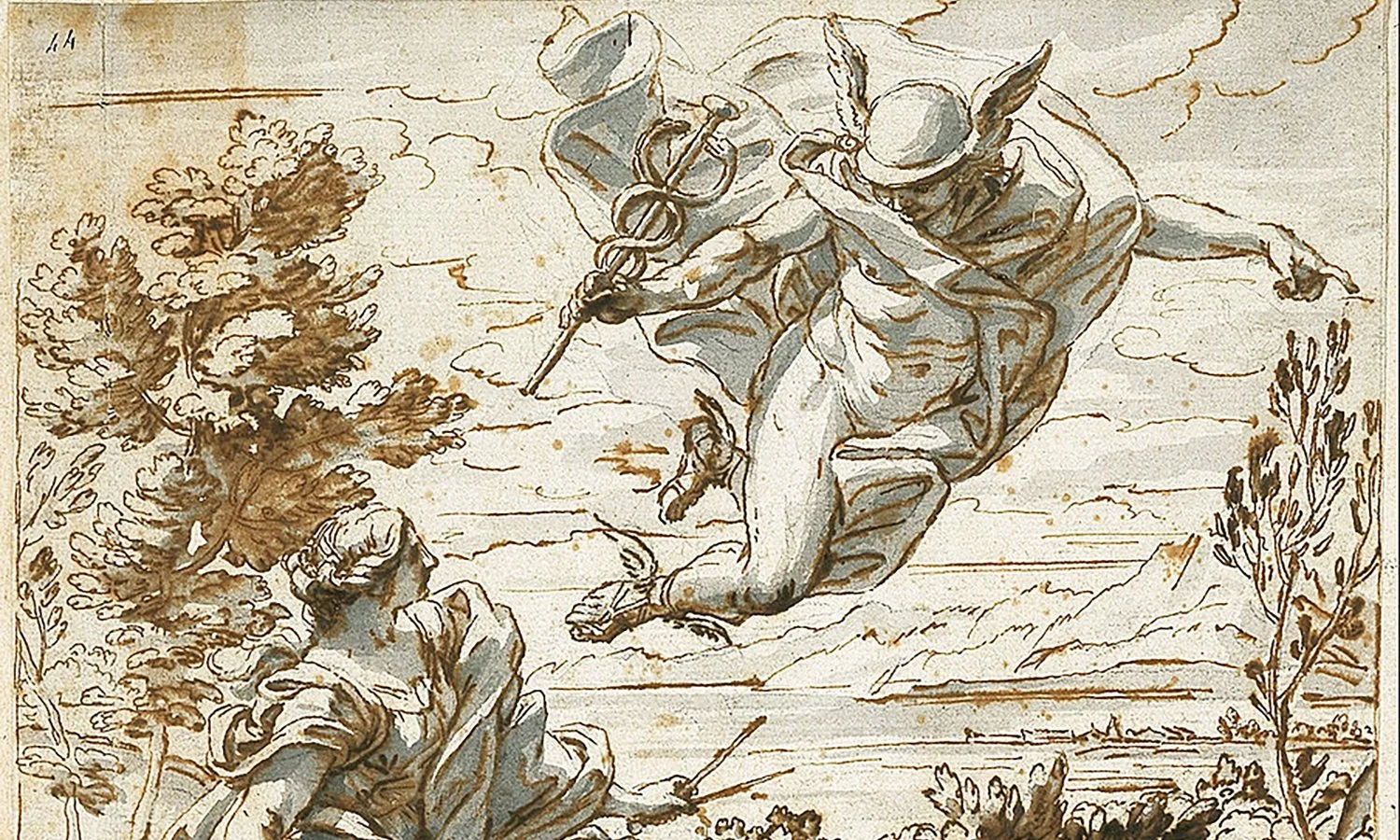
“Hermes Leading Geography,” painting by Giovanni Battista Gaulli (1639-1709). Wearing winged sandals and carrying a caduceus, the youthful Olympian god Hermes serves as the messenger and mediator between the human and divine realms, as a playful trickster, and as the guide and guardian of travelers.
THE STORY of the blissful, then tormented by trials, then happily-ever-after romance of Psyche and Eros first came to my attention at age nine, via The First Book of Mythology by Kathleen Elgin, a stylishly illustrated childrens’ book introducing the myths and legends of ancient Greece and Rome. The whole family tree of the Mediterranean gods was shown on the artful end papers and the drawings for the stories were indelible. I can see them even now: in the illustrations for Psyche’s story, Eros had blue–black curls and wings. Psyche herself wore a long, one-shoulder dress that looked like an elegant evening gown. She wore the gown when stealing through the palace at night, when suffering trials, and even when flying through the air. At nine, I puzzled about most aspects of the story but did absorb one, enduring fashion pointer — find a versatile dress! — and was excited to discover that the Greek word psyche means soul, mind, and spirit.
How simply it begins; from household shelves come tumbling myths, golden boughs, democracy, a domain of the Muse. For a traveler from the West, Greece is so saturated in myth, history, art, and ideals that we inevitably journey there in imaginative as well as physical geography. I first set out from Boston for Greece in the summer of 1989 with another poet, my peripatetic friend Katherine. Our husbands, Peter and Tony, are to join us later. On an “Olympic Flame” jet, the other passengers are predominantly Greek–Americans returning to the homeland, and immediately after dinner, they rise from their seats to roam the aisles — patting arms, laughing, showing wallet–crumpled photographs, and speaking exuberant Greek. By the tones of voice, it seems that these passengers are not necessarily old friends greeting each other on holiday; rather, the fact of returning together has made an instant airborne community of citizens of the diaspora. Two hours ago, they were diffuse in the melting pot of America. Now they are the concentrate of a people. Zooming into the night across the Atlantic, we are already in a festive Greek world.
These days some tourist journeys to Greece are to sun-and-fun resort compounds that hope to minimize what one resort owner calls “the problems outside the hotel,” by which, presumably, he means Greece. One eminent classicist whose lifework has been an investigation of pre–Socratic literature, will no longer actually go to Greece, where, he says, the old, sacred sites are overrun by tourists and sullied by misapprehension, where the ancient sounds are lost even to the Greek tongue. Hellenism is elsewhere. I admire this scholar. Still, I have packed a copy of Richard Geldard’s Ancient Greece, in which he dares to say that “the gods have not vacated the holy places...If there has been any vacating, it is our own ‘vacation’ from the myths of sacredness within ourselves.” Traveling with neither a Hellenist’s pure vision, nor the wish to loll on a raft in a tourist compound, I have come to Greece to see what this land has to tell us about right habitation. The question has a special charge in Greece because it was here that Western culture began to propose not only answers but whole traditions of how to ask.
Guide of all travelers
That the geographies of place and spirit are mingled is clear from the very first day of our four weeks in Greece. After a hot taxi ride from the airport into Athens, Hermes, the trickster and guide of travelers, promptly manifests in our hotel lobby. The hotel has a handsome, sepia–toned frieze of archaic figures and fish that runs along the wall just below the ceiling, and just under the frieze there is a living row of tourists who are not jumping bulls acrobatically but are slumped on suitcases and duffel bags. The desk clerk, Rafael, who booked and twice confirmed our rooms by overseas telephone, has a humble–pie, fatalistic smile as he says to us: “I have no room for you.” I like the way he does it. It’s not an apology, nor in the least cavalier. It is a fact that he delivers, with the dignity of a fact that has been visited upon us all by some fact–making force located elsewhere.
Somewhere, something has ordained that Rafael give away our reservation to the large group, now sitting under the frieze, from Sunshine Tours. Rafael gets to the better news: he has arranged for a room in another hotel just down the street and he will carry our luggage there. Rafael is a thin man, perhaps mid-sixties, who resembles Fred Astaire. He doesn’t look like he should carry our luggage single-handedly, so we share the lugging. The three of us make a slow procession through the old city at the base of the Acropolis. Tired, hot, disappointed, Katherine and I trudge with Rafael up to the substitute room on the top floor of the small Hotel Plaka, which is painted a deep, gleaming blue.
Opening the door, we enter what must be one of the best rooms–with–a–view in all of Athens. The large, airy room has tall casement windows that open wide and frame a majestic view of nothing less than the whole temple complex of the adjacent Acropolis.

The Parthenon on the Acropolis, roughly the view from our hotel window; photo by Bstefanov, Dreamstime
We stand mute before the close, shimmering marvels, then turn and thank Rafael for this remarkable gift. He glides away with a smile. I lie down for a fifteen-minute rest, which turns into a sleep into the next morning, from which I awaken now and then to see the temples just outside our window. In the afternoon sun they are a bleached white; at dusk, the marble melds into the gray blue sky; by night, the limestone hill and sanctuaries are flooded in bursts of diamond–bright gold and red light from projectors. From midnight to 3am, a light rain of songs and music floats from tavernas outlined in strings of lights and terraced into the slope of the Acropolis. With dawn, the temples are flushed rose, and the Greek flag is being raised.
Like nearly all late twentieth century cities, Athens is both toxic with pollution, and a monument to an idea that seized cities in the 1950s, stripping the old, settled, and eccentric, leaving behind grey, concrete, modular buildings. I am a fan of modernist architecture, but the Athens built during the thrall of urban renewal is a city whose poured-concrete architecture brings to mind the solacing words of Le Corbusier: “There is enough ivy in the world to cover all the bad buildings ever built.” Wonderfully, one patch of built Athens was left intact. This zone, the oldest part of Athens, has been continuously occupied since the Neolithic era. Now called the Plaka, it surrounds the Acropolis in a square mile full of the stucco and red tile structures, narrow winding streets, and overhanging trees and vines that once comprised all of Athens. Here are pale butter–colored dwellings, wrought–iron stairs spiraling up the sides of houses, purple–blue painted doors, and flowers spilling from old olive cans and from cracks in the stonework.
Outside this oasis, some parts of the city, like all cites, are less appealing, visually. But they do call to mind the post–travel experience of returning to one’s home place and seeing familiar, loved streets as though for the first time. How middling some of the local fences, stores, and neglected landscapes can then appear. But most of the time in a well-known place, we are quite beyond the hyper–alertness needed in a new place and free to focus on appealing particulars, a bolt of cloth in a window, a block with dappled shade, the scent of lavender from a garden. And too, many a lackluster road leads to someone dear whose image overlays the physical route. The unknown city, as yet unrelieved by the cushions of familiarity and affection, gives us a great gift: it opens the senses wide to an undifferentiated, uninterpreted sensory flood. Continually orienting, absorbed, surprised, and by end of day utterly spent, a traveler resembles a child. And gradually, the peering and marveling at other ways (still hauling goods by mule! votive shrines in airports!) elides into the traveler’s essential discovery: that the ways of one’s own culture are just as curious, as idiosyncratic, and as rooted in the chances of history.
At the Botana
Our initial quest in Athens is to an appliance store. The merchandising style of this city has the feel of a bazaar: sandals, rugs, tables of books, pyramids of food, carts of steaming hot corn peddled in ninety–degree heat, and racks of clothes take up the slender sidewalks, on which few Athenians walk, preferring the streets, where they weave among traffic, calling destinations into the windows of taxis with fares, hoping to piggyback, an energy efficient custom that adds to the bustle. A few blocks after exiting from the appliance store with a world–wattage hairdryer in hand, Katherine and I see a tiny shop with this beguiling window display: a basket of tall, dried herbs, two candles in the shape of roses, a hefty stack of beeswax and votive candles, and paperbacks with illustrations of women and fantastic landscapes. We go right in.
The shop is called a botana, a speciality shop for herbs and herbal medicines. Cool, dim, eight feet wide, maybe fifteen feet deep, one of its walls is lined from top to bottom in dark mahogany drawers, the other is composed of open shelves stocked with candles, incense, and books. Three ancient women tend the shop. All three turn slightly to look at us as we enter, then continue weighing and measuring amounts of dried and powdered plants into small brown paper bags. Along the back wall are five chairs on which are seated three silent customers. The preparations proceed at a deliberate pace; the women collect substances from drawers, crush them in a mortar, funnel them into bags, occasionally ask one of the customers a question.
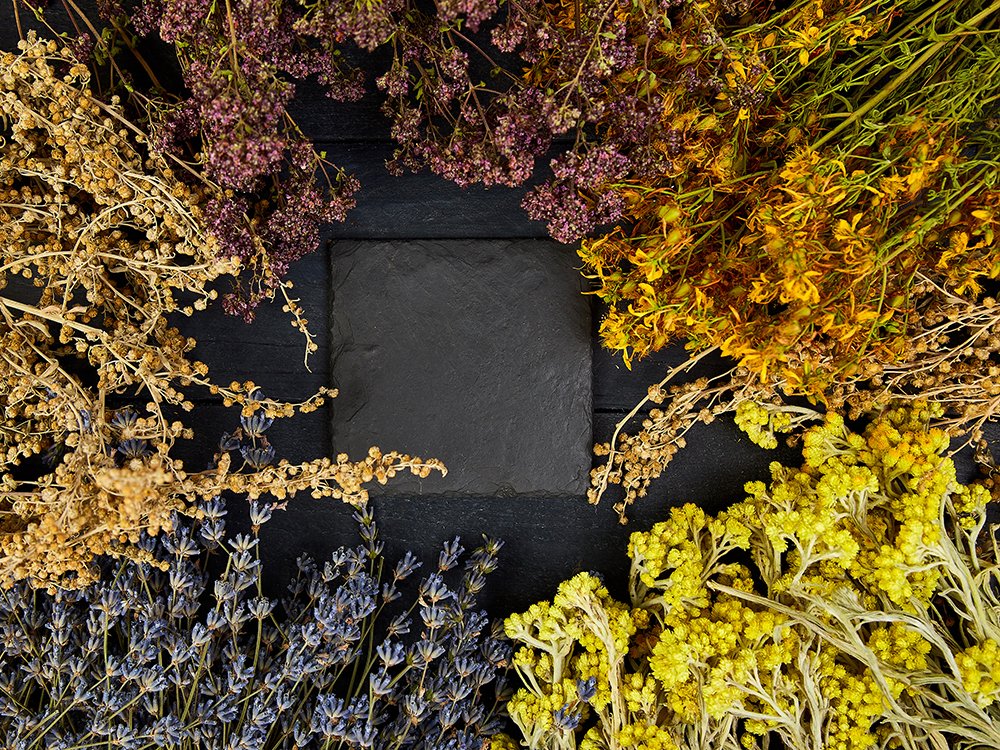
dried medicinal herbs, image via iStock
The shop’s thin, pliant beeswax candles are sold in banded bundles of one dozen. When I pick up two bundles, the shop women again turn slowly in concert to give me a look (uncannily like the three deadpan musicians of Sid Caesar’s enigmatic Nairobi Trio). Of the dried plants that are stacked loose in large boxes on the floor, some are recognizable, including branches of bay leaves (also called Daphne), long wands of oregano, and bunches of thyme. I select some of these plants to buy, gently prying the stems and leaves from the heap, and take them to the shop counter to be wrapped. Store packaging in Greece typically follows one of two approaches: either the goods are dropped into a very thin plastic bag, or they are hand-wrapped, carefully, in a strong paper, often one printed with a floral pattern. If a store handwraps, even a purchase of five post cards is wrapped as though it were a gift. When one of the botana shopkeepers finishes compounding her remedy, she takes the candles and herbs from my hands and rolls them in heavy pink–brown butcher’s paper, making a big bundle flared like a bunch of lilies from a florist.
Bumping so immediately into the botana, I assume that there might be many herbal medicine shops in the city. Later, when I mention the shop to a native Athenian who teaches urban planning and architecture at the Polytechnic, she is quite interested. Could I tell her how to get there? She knows of no such shops. I’m surprised the shop is as rare as all that, but it is no surprise that herbalists have become scarce. Plant lore emerges from intimacy with the land and, like great basketball teams, relies on a large pool of youth eager to continue the practice with each generation. Like traditional healers everywhere, the women in this botana are continuing a vestige of a paleolithic culture in which the Earth was understood as alive, and the principle divinity was a goddess. Her primary emblem was the tree, and in the Mediterranean world her name was Gaia. Perhaps the balmy air, light, and waters of Greek Christendom have been more tolerant of the pagan sensibility about the earth than elsewhere in the West.
As the twentieth century closes, we have no common, respected vocabulary to name and cultivate the experience of an innately valuable Earth. Such language has been strategically avoided by contemporary twentieth century environmentalists as they have made the case for protecting the natural world in terms appealing to pragmatic legislatures and a materialistic society.1 As a result, much environmental talk values the planet primarily as a storehouse for human use and assumes that value is determined by human needs; we are urged to care about, say, rainforests because they supply sources of medicine and help regulate the Earth’s climate. However, when the Earth’s value is determined by utilitarian values, which are given to fluctuation and change, the planet and source of our well–being remains at risk.
Standing in the botana among the pungent plants, it’s possible to sense an older, more intimate connection with the rest of the natural world. The drawers of powders, tawny stems, roots, and drying flowerheads give off a subtle, spicy aroma, and a quiet meditative mood. It is our first day in Greece: my only Greek is “F. Harry Stow,” a phonetic phrase for eυχαριστώ, the Greek word for thank you. “F. Harry Stow,” I say to the women who solemnly press the flared package of herbs and candles into my hands. We exit into the bright light of downtown Athens.
“The Sacred Rock”
Much attention is given, rightly, to the temples of the Acropolis — their scale, majestic design, and significance — but compared to the massive rock on which they rest, the buildings are a delicate filigree. The temples are built on this outcropping because it is an astonishing geophysical event: a mass of coarse, semi–crystalline limestone and red schist that rises five hundred feet from the surrounding flat plain, forming a vertical wall of overhangs and clefts, the summit inaccessible save on its southwest slope. Chthonic is the word that my classics professor used for the underground forces that produce such upheavals of the Earth. From the city below, the great rock may be seen at any time of the day or night, by chance: as one turns a street corner, looks up from the newspaper, sinks into a taverna chair. The hill and its temples are a constant, and remain dignified even when lit by the flashy evening light shows. The rock fairly radiates, shimmering above the Plaka, the bouzoukis of the cafés, the juntas, and shifting political coalitions.
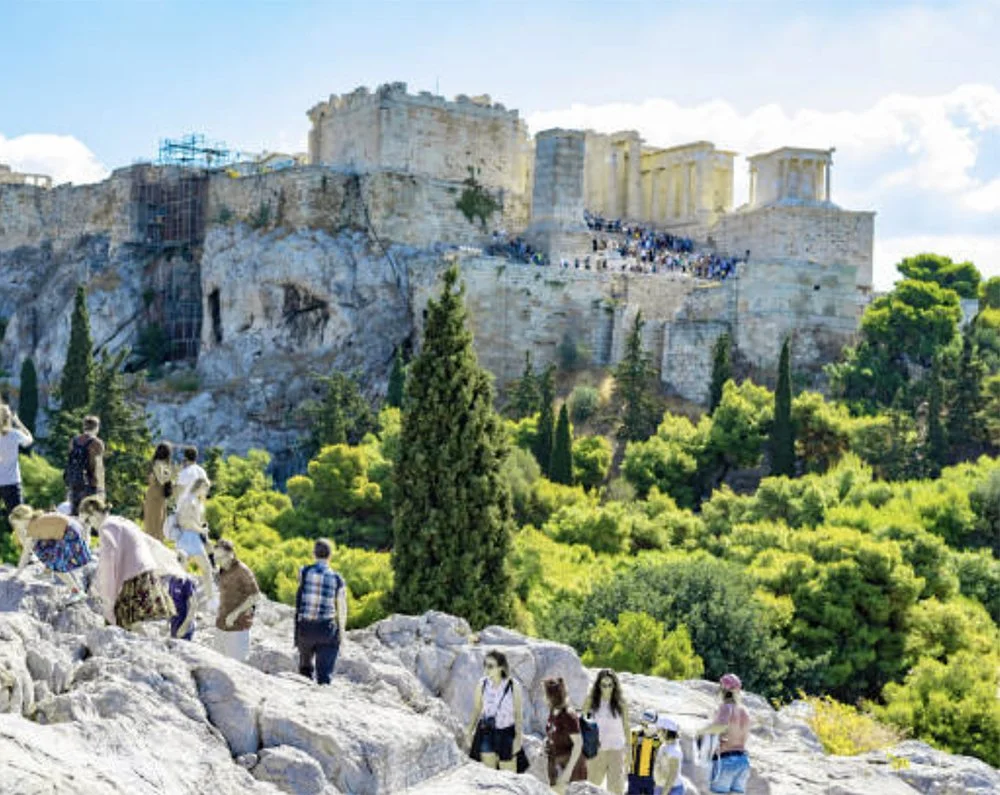
View of the massive rock outcropping on which the Acropolis in Athens, Greece is built. Photo by Davidf.
For ancient Athenians, the rock was an ideal plateau from which to invite the sky gods into their city. At this time of year, ancient citizens would be approaching the culmination of months of activities that prepared a soul to meet the divinities on the annual summer pilgrimage called the Panathenaea. It was a spectacular procession during which the fierce summer sun might help intensify and shape consciousness for the passage through the Propylaea and the gateway structures which draw the eye steadily upwards.2
Now as Katherine and I wend our way up the hillside along the dusty processional path, Athens begins to recede to a patchwork of bright reflections from hundreds of solar panels mounted on the flat roofs of the city. The whole path is flanked by handsome twisting olive trees, the sun is strong, the maquis aromatic with pines, rosemary, and roseberry spurge buzzing with bees. Up close, shrubs reveal large snails, the color of deer, clinging to the inner, shady limbs. Among the temples, not even a sparse pine gives shade against the sun. In truth, it was easier to study their grandeur in the slide lectures of art school, where the Parthenon was a wall–size rectangle of light glowing in the dark. Beside the actual, awesome edifice, I feel off balance. Perhaps that is intended?
It’s easier to take in the small Erechtheion, the sanctuary whose south porch is supported by the six famous stone women, the Caryatides. The image of endurance, these statues weathered two thousand four hundred years of time, invasions, and the use of their temple as a church, a harem, and a military powder magazine. When they at last succumbed, it was to one of the lightest subtances. During the 1960s, Athenian air grew so corrosive that the eyes, noses, gowns, and thick braids of the Caryatides began to dissolve. Replicas were installed, and the original statues removed to a climate–controlled exhibit case in the Acropolis Museum. It is a familiar story by now in cities with great marble and limestone heritages, but I am brought up short by the instance of the Caryatides, with their strong arms, neck–bolstering braids, and calm eyes. To the south and east of the replica Caryatides and close by Athena’s urbane temple stood the two–winged stoa that was the sanctuary of Artemis Brauronia, the wilderness goddess. Greatly honored in the gorges and forests of Greece, especially in Arkadia on the Peloponnese, she was also judiciously invited into the heart of the human city.
“None of us ever sees her”

Temple of Artemis at Brauron, iStock
These days in mid–June are the longest of the year, and one afternoon in the remaining light, we drive first south to Poseidon’s Temple on the bluff of Sounion, and then north again through the olive groves and vineyards of the Messogia Plain to Brauron on the eastern coast of Attiki. Near the sea, with the Erasinos River nearby, the road goes uphill, then downhill into a forested valley. At the entrance to the excavated site at Brauron, the gate is closed, as we are several hours too late. Far off the road, half–hidden by tangled vines and woods, stand three columns, insubstantial as a private, tumbled-down porch. We stand for a while in the failing light peering at the slender evidence. I know from reading that there is a fountain inside the gate, and a crack in the wall of the sanctuary behind which lies the tomb of Iphigenia, the princess who was either (according to Aeschylus and Euripides, respectively) slain by her father, or saved at the last minute by Artemis and brought to Brauron to live as Mistress of the Animals.
It has happened several times before on journeys that something I especially wish to see or visit withholds itself. Travel is like knowledge itself: much remains unknown. And, too, the direct gaze, for all its virtues, can obscure. Here at Brauron, dusk is arriving, cooling and dimming the fields. We drive back toward Athens, stopping along the way at an empty taverna by the shore, where tables, their legs sunk in sand, are scattered through a grove of olives that grows nearly into the sea. In a strong, clammy wind, the leafy olives are a froth of silvered green. Hurricane lamps glow on the tables, and in the harbor, lights pulse on inside the cabins of boats. The boats shine through the trees and the lines between sky and water, trees and tables grow indistinct.
It occurs to me that having eluded our eyes, the shrine to Artemis at Brauron reveals something essential about the wilderness goddess. As the Princess Iphigenia says, “None of us ever sees Her in the dark or understands Her mysteries.”3 Historically, Artemis is an aspect of the Earth goddess, not Gaia herself, but the goddess of inviolate nature, wilderness in the old sense of being “unto itself.” Artemis is otherness — that which cannot be fully possessed, known, or controlled. Of all the divinities, she is the most solitary and the most contradictory: she carries a quiver of arrows, her name means “she who slays,” yet she also tends the mother in childbirth and protects the tender young of the world. She is the twin of Apollo and while her brother rules in the sunlight of the city, she moves in moonlight.
Greening Athens
The problem of statues dissolving and human eyes burning in Athenian smog are among the issues that Droussoula Vassiliou Elliot aims to remedy. Droussoula and her husband, Sloane, are publisher and editor-in-chief, respectively, of The Athenian, the English language magazine of Greece. Sloane is slim and erudite, a dry wit, a watcher of Greece by profession and by marriage. Droussoula is kindly, intellectual, and able to effect city–wide campaigns from her desk using only natural grace, a telephone, and a vast network of allies and friends. Her family has lived in Athens for centuries, and I am not surprised when three people from the U.N. Global Cooperation Project show up in Droussoula’s office saying that it is their Greek headquarters. I have arrived in her office to talk about her idea to, as she puts it, “green Athens.”
Ten years ago, Droussoula Elliot launched a children’s nature club that has by now greened the first batch of what she hopes is a generation of ardent Greek naturalists. Recently she has been helping to organize a campaign to protect the Mediterranean sea turtle. But the scheme dearest to her heart is to cover the buildings of Athens in living flora. From her large office window, Droussoula can envision the ubiquitous balconies of cement high-rises, apartment houses, hotels, and offices draped in lush hanging gardens, vegetation spilling from every sill and rail. This, she declares, rightly, would greatly purify the air. The plan is the response of a woman who looks out her window every day to see haze drifting across bleached buildings whose hot balconies bear only the rare plastic chair. And, in her hands, a green transformation is not a quixotic idea.
Over lunch, Sloane Elliot tells me about another, older Greek tradition for protecting people and places. Twenty years ago, when the Elliots were traveling in New York with their new baby, the infant’s temperature suddenly soared. A doctor treated the baby, but his temperature did not drop. Droussoula called her sister in Athens. The sister asked only if the baby had been in crowds. Yes, they had stood in front of a theater briefly where many people had admired the baby and several chucked its chin. Well, obviously, the sister said, the baby had been affected by the evil eye. (More later on what that is.) Over the transatlantic cable, Droussoula’s sister led her through the ceremony to remove the curse. Immediately after the ceremony, the baby stopped crying, and his temperature dropped to normal. In Droussoula’s family, knowledge of how to give and remove the evil eye has been passed from a grandmother to an uncle to a sister, who will pass it on to a son — always woman to man to woman to man. Sloane tells me these things in the tone of someone who only discovered ice cream as an adult and is just never going to get over the fact that ice cream exists.
We are lunching at a taverna situated only inches from street traffic, and as the waiter brings fragrant bean soups, a car ruffles the tablecloth. Undisturbed, Sloane advises me on how to recognize the evil eye, which in Greek is called “the mati.” Still, you may just be sick, or having a normal streak of bad luck. How can one tell? It’s quite simple, he says. Take a glass of water and pour a small amount of oil on the surface. If the oil gathers together in one floating island, as it would normally do, things are just going poorly, but if the oil stays scattered on the surface of the water, then you have been affected by the evil eye. A second way to know is to say a passage of Christian liturgy quickly: if you can say the liturgy fluently, you are just having a bad time of it; if you scramble the words, it's the evil eye. Curse removals can be performed by an Orthodox priest or a lay healer, and prevention is also possible: wear a blue bead painted with an eye and, when in situations that invite the evil eye, pretend to spit. “Pwppitt,” Sloane says, pretending to spit into traffic. If only the New Yorkers had taken this simple precaution when cooing over his new baby, they could have deflected the harmful spirits by pretending to disdain lovable babies.
Belief in the mati and in rituals to prevent its energy, dates to at least the sixth century BC and continues to be respected as a part of cultural identity by citizens throughout Greek society. The injurious evil eye is caused by envy, and the concept seems a profound bit of psychology to help level things in a community. All societies, and especially ones based in cooperative ventures like fishing and farming, value the equitable distribution of goods; but life is ever inequitable and this can produce social unhappiness.
It is this unhappiness, born of suffering and inequity, and the limited human power to remedy it, that is addressed by the ancient mati tradition. Belief in the evil eye locates the sources of envy: first, in the successes of the fortunate, and secondly, in the longings of the less fortunate. It instructs the successful to bear the burden, the potential curse, of their success, and suggests that they guard against the evil eye by tact and discretion, and by plowing their good fortune back into the community so that others have to reason to feel more grateful than envious. The belief acknowledges the variations in awareness that people bring to social life: some maliciously convey the evil eye; others unwittingly infect their circle; still others learn to purge themselves of envy and dispel curses. By all these means, the ritual modulates the imperfect scales of fate. Behaving like nature itself, the evil eye is neither entirely beyond, nor entirely within, human influence.
The host/guest tradition

Taverna of the Psarras; Plaka neighborhood, Athens, Greece
“I defy you to find poverty anywhere in Greece as wrenching as what you see on Washington Street in downtown Boston, any hour of the day.” Kostas Gavroglu makes this claim in his quiet professor’s voice, at the Taverna Psarras, where Katherine and I are about to be treated to some justly famous Greek hospitality. Kostas and his wife Anne have been alerted to our arrival by a mutual friend, a philosopher of science with whom Kostas and I have both studied in America. The generosity the Gavroglus shower on us is an extension of their great regard for him. We learn that Greeks go to a taverna for dinner not before eight–thirty in the evening. Nine is better; ten o’clock prime time. Out of deference to our recent arrival from Boston where restaurants often close at ten o’clock, the Gavroglus come to our hotel at eight and lead us on a walk up the hill, through courtyards and shops, arbors, and strings of lights, until we reach the Taverna of the Psarras, which means fishermen.
Outside the fishing villages, where, as we later learn, the price of seafood scarcely shows up on the bill, fish is quite expensive in Greece. But Psarras is a rare city taverna that serves fresh, affordable fish. In other ways, too, Psarras betrays village roots, its pace stately as a sleepy town. It is the one taverna in the foothills of the Acropolis that makes no special appeal to the tourists flowing up the hills, leaving to other eateries the practice of lining the cobbled streets with suave men calling out price, quality, and invitations in whatever tongue they suspect a visitor might speak. At the Psarra, a dozing fellow notes one’s arrival from his chair by the door, nods, and sometime later comes by with the standard taverna issue: paper tablecloth, a basket holding the bread, and silverware wrapped in napkins.
A vast tree grows in the center of this café; its limbs and leaves shade thirty tables, the kitchen structure, and a nearby leather shop. Logging and stock–grazing severely deforested Greece as early as 300 A.D., and since these practices have continued, trees and springs are always welcome events on the landscape.4 (Some days later, within a few hours of driving down the eastern prong of the Peloponnese, it’s clear why shade and water, and their sources, are revered and have been since the time of the pastoral poets.) It is an excellent sign when a taverna, or anything else, is located under a tree.
Under the large Psarras tree there is a medley of chairs and tables. Most city tavernas have molded aluminum chairs, but the Psarra uses wooden tables and wooden chairs, and, like the country tavernas, paints them in many shades of blue: teal, navy, dark, light, and sea. It occurs to us that the color blue is the national hobby! Another day, in a bright midday June sun, a woman of perhaps eighty–six slowly re-paints ten of the Psarra’s wooden chairs; she uses a two–inch brush and a half–pint can of blue enamel, no drop cloth, merely careful strokes, and a tolerance she shares with her culture for the fetching splatters of color that land on floors and stucco walls. Boats and chairs, windows, walls, and the hook–necked gourds hung to decorate the undersides of arbors are just a few of the things painted annually in Greece; the painting places are easily found, marked by layers of polychrome speckles.
For dinner for four at Psarras, Kostas orders the following: fried squid; gopas, a large bony fish from the sardine family that is easily filleted, leaving a limber Fritz–the–Cat cartoon skeleton; greens similar to collards; thick ovals of fried potatoes; salads; plates of steamed zucchini; bread; wine; and a plate of cut lemons. Twelve plates are crowded onto the table and, while small individual plates are handed to each diner, it is clear that to use them as more than a staging or boning platform is gratuitous. Over a long, courtly, warm evening Kostas and Anne demonstrate that the famous host/guest tradition celebrated in the Odyssey has endured. And they show us how to eat in a taverna; they initiate us into the foods, the manners, and, without speaking of it directly, point us toward the significance of the village taverna.
In a fishing village

Panayia Gorgona (Chapel of the Mermaid)l Skala Sykamineas, Lesvos; photograph by Emiralikokal, Dreamstime
Two weeks later, Peter and Tony have arrived and we have all converged on the remote fishing village, Skala Sykamineas, on the northern coast of Lesvos, we have learned just enough to enter into the traditions that are cultivated throughout Greece in the village taverna. There must be many flavors and versions, depending on location. This particular version is created by the situation of Skala Sykamineas: it is by the sea, has rich soil for vegetables and melons, and is remote enough that cruise ships don’t swarm, but close enough that a few will come each week in season, providing needed income. It has an enormous boulder just offshore that provides the anchor for a harbor wall and a broad enclosure. The wide rock promenade snugs the fleet of fishing boats and provides a place for infant prams, teenage courtship, and elders climbing to a minute chapel perched on the rock. It has a family–run taverna that serves as the public living room of the village, open from dawn until after midnight.
A thriving taverna acts like a clock of the hours of each day. Throughout the long Mediterranean day, foods stream into the living room in baskets, sacks, plastic containers, and shopping bags. A back door exists in the building is used for taking out garbage, but suppliers to the communion make their deliveries by crossing the shaded front apron of the taverna among the table and chairs and diners, entering the wide front doors. A typical early morning delivery here begins when a Dutch couple place an order for yogurt with honey; minutes later a woman brings four containers of fresh–made yogurt from her neighboring house. A wiry farmer lugs in a lumpish burlap bag of onions; the taverna owner strolls up from the shore with a round basket full of glinting sardines. By ten o’clock, the first of a daylong procession of six–year–old boys scampers in with a limp octopus or an eel held by the gills. The baker sends his assistant down the small hill with a shopping bag of hot, fresh rolls. Not only suppliers, but diners are expected to come into the kitchen to order from an array of hot dishes and chilled fishes. Next to the food cases, the one telephone in the village sits on a shelf next to the tomato harvest. The walls are encrusted with snapshots of the owner’s family linking arms with tourists, cousins, and returnees from Athens and Kos.
Sitting is a constant and important activity in and around the taverna. Early morning sitting is done by fishermen returned from nightime lamp–fishing; after unloading the catch, they sit at the edge of the docks near the taverna on large baskets, each of which holds a pale yellow rope net. The nets are laced with corks and hooks and after each use the men rearrange them, smoothing all the hooks in one direction. Even earlier morning sitting is done by clusters of women at the work-tables inside the taverna: they peel skins from braised tomatoes, chop them along with garlic, herbs, and onions, and shape the mixture into shiny mounds that will be added to rice for a stuffed squash blossom treat served at this time of year.
Perhaps the earliest morning sitting is done by dozens of cats, motionless before the bows of unloading fishing boats until a silver fish comes flying from the deck. As it lands on the dock, the cats transform into a flurry of fur and claws. Greek cats are thin, foxlike creatures, whose ears are quite large in proportion to their delicate heads and jaws. The cat population is substantial and fends for itself; these cats are not pets but hard–working members of the town. No sitting is done by children in or near the taverna; instead they chase cats, play between the tables and chairs, chase more cats, and prance by with aquatic things in their hands.
Mid-afternoon sitting is done by the older men, who take their places, soundlessly, at a row of tables that seem reserved for them. Wonderfully, the word for “occupied” in Greek, as in “I am occupied just now,” includes the meaning “I am sitting!” The older men have reached this purest meaning, for although they can be drawn into political talk and sliding checkers across a checkerboard, most often the sitting of these village elders appears to be entirely unsullied by any motion or worldly distraction. Late night sitting is done by the oldest women in the village, who sit on the floors of their porches and courtyards, in groups of six or more, with their black–stockinged legs straight out. They crochet curtains and napkins while eating bowls of popcorn, talking and laughing into the wee hours, as late as two o’clock in the morning. Just before the grandmotherly women emerge for night-sitting, the aroma of hot oil and corn rises, and the street smells like a disembodied movie theater.
Some sitting is episodic: a peddler appears in town, and lays out his goods on a stone wall: tin plates, Swiss army knives, keychains, cigarette lighters, and pictures of the Madonna. He then sits near the display for a week, drinking coffee in a chair under a nearby awning. Some sitting is hard–won: waiters shoo a small group of Romany women away from the taverna, again and again, and then, once or twice during the hottest part of the day, relent, allowing the three women, who are selling bundles of one-dollar tablecloths, to settle on a shady bench and drink glasses of water. Tourist sitting is more desultory, done at all times of the day. A German woman sits for hours reading Kierkegaard, alone. At noon, a cruise ship drops anchor beyond the harbor and brings four hundred passengers to the taverna for lunch. A huge, unshaded terrace to one side of the taverna has been created for just this purpose. The terrace, normally entirely empty, is suddenly occupied to bursting for about an hour.
At nine–thirty or ten o’clock on weekend nights, beautifully dressed clusters of former natives arrive in the taverna from their homes in the city. After the second World War, the horrendous civil war in Greece continued, with much bloodshed. The prevailing regime found ways to round up villagers and persuade them into Athens. The city was swollen within a few years to four times its former population, and many villages withered. The migration into Athens continues, and many city dwellers now drive back to their home villages on Friday and Saturday nights. They come in couples, in groups of six or eight, and cluster around one long table, reuniting with parents, friends, a brother who stayed. They order the catch of the day and, at this time in mid–June, kolokithia lololuthia, the small, folded squash blossom pockets filled with rice, rosemary, onions, and cheese. These fresh, ephemeral delicacies are a candidate for the finest of all the delectable culinary treats we discovered in Greece.

Fresh squash blossoms to be used for Kolokythoanthoi, a stuffed squash blossom delicacy; iStock image
After dinner, the fisherman brother, who lamp–fishes during much of the night, leaves the others at the table and motors his boat quietly out of the harbor. In a while we see his lamps set out in a string, like Christmas tree lights bobbing on the surface of the sea. The others linger: one young man has brought his guitar, and one of the women stirs her friends into singing Greek folk songs. After the singing starts in earnest, the taverna owner’s son Nikos lowers the taped Theodorakis music that comes from a speaker wired in the tree, and the returnees have the floor to harmonize for the night.
In June, at the harbor taverna of Skala Sykamineas, the evening air is reliably balmy and breezy. Each night, the four of us gather during the early evening when light bathes boats, cats, trees, faces, and stones in an intense coral light. We sit at a blue table on blue chairs and report on our field trips. Peter, who spends part of each day underwater in a mask and flippers, draws a detailed picture of a fish with blue wings and eight legs that he saw flying along the harbor floor. We believe him. After the sun slides behind Turkey, lights strung through the myrtle trees come on. We order food in the manner of Kostas: marrow in lemon juice, greens, and fish. Now and then our forks, approaching the same potato oval, clink in midair, in the ordinary communion of the rural taverna.
Translations
The small cement terrace of the pensione where we are staying is lined with gardenias growing from olive oil cans and crisscrossed by a clothesline hung with black slips, lingerie, and pale blue paper lanterns that recently held candles for the feast of “Ag-yee-a Mar-tha,” Saint Martha’s Day. It is after dark and already, just outside the terrace walls, a line of senior ladies has begun singing songs that come through the walls of Afrodite’s Rooms–to–Let. Afrodite’s daughters, twelve–year-old Nikki and eleven–year-old Tule, sit with us at a picnic table on the terrace where their mother has put two reading lanterns and a plate of honey–dripped sweets. The girls bring lined composition books in which they have written stories, for us, in the rudimentary English they have learned in school. To practice, the girls want to read their stories aloud. Nikki has enough English to make infant sentences, Tula less, and we have only a few Greek words. In the traditional manner, we all make up for these lapses with smiles and pantomime.
In Nikki’s story, called “My Friend,” she goes to the beach with Evgania, a girl just her age who lives in the one grand house in Skala Sikiminias for four months each year and goes away to school in Paris for the other eight months. The story is about what they do during a summer day and how much they miss each other during the winter. When Nikki gets to the part about the beach, she pauses and asks me the English word for something the girls are making at the water’s edge. She describes the activity, but I cannot make out what she is talking about, so Nikki begins to draw a picture of a circle of stones in the off–shore shallows. Nikki’s stones are ovals, carefully shaded on one side. Next she draws something inside the stones. It looks like a net that the rocks hold down in the water, keeping it fixed in the sweeping tides. And then she draws some fruits in the net. Ahh, finally I understand: she is describing a circle of stones in the water to hold fruits and keep them cool in the sea, something for which there is one word in Greek. Now Nikki turns to me excited to hear the equivalent English word.
Another night during the English lesson (and lessons in Greek life for me), I ask Nikki if her mother makes any medicines from plants. Yes, of course she does! Nikki is so charming and eager to practice her English that she will talk about any subject, but I see from her perplexed look that she considers the subject of how to make cough syrup from olive trees too obvious a body of fact to support any interest. It is as though I have asked her to tell me about the fascinating custom of hanging clothes on clothes hangers. I’ll later learn from the clerk in the village craft shop that many of the women in the village are skillful herbal healers. Until the twentieth century, such botanical healing was considered a scientific pursuit, and by chance, the most prominent botanical scientist of the ancient world came from a small village just thirty miles to the east of Sykamineas. There, in Skala Eressou, Theophrastus, successor to Aristotle as director of the peripatetic school of philosophy, kept his garden and wrote the Historia Plantarum, a treatise in ten books, in which he distinguishes the habitats of plants.
Poems in situ
Lesvos was also famously the home of the poet Sappho. Less well known is a contemporary master who also traces his heritage to this coastline. A few miles to the west of Skala Sykamineas, on an unmarked country road, stands the Alepoudhelis family house. Both the mother and father of the poet Odysseas Elytes (nee Alepoudhelis) were from old families of Lesvos, and it was boyhood summers on Aegean islands that saturated Elytes’s language in light. He writes poetry that comes, he says, from “an alphabet of the Aegean:” the garden of the sea, olive trees, above all, the light. Often described as surreal, reading them here, in situ, the poems seem like an entirely accurate portrait of the island. About these matters, Elytes has said that he and his generation “have attempted to find the true face of Greece. This was necessary because until then the true face of Greece was presented as Europeans saw Greece.... [W]e had to destroy the tradition of rationalism which lay heavily on the Western world.... Many facets of surrealism I cannot accept...but after all, it was the only school of poetry... which aimed at spiritual health.... [I]t had cleared the ground in front of us, enabling us to link ourselves physiologically with our soil.”5
On the Summer Solstice
Near dusk one night during our time on Lesvos, as I am heading back to Afrodite’s Rooms–To–Let through a small woods, I come upon a group of women and children lighting three large brush bonfires on a scruff of beach at the outer edge of the village. As the women touch matches to the three piles of brush, the sun is just setting, and for half an hour — until the bonfires burn down — four orange–red shapes flare against the evening sky. As the sun slips into the sea and the flames diminish, the women and their children turn into silhouettes against the sky and sea. One thin boy, about nine, suddenly bolts from the cluster and leaps over all three fires, one after another, whooping. His small, wiry body, at apogee over the low flames, looks like a shape the fire has thrown up.
Next a girl runs forward and jumps over the fires, and then all the children do, sometimes several times, like kids shooting down slides then running around to do it again. The mothers stand together, talking, along the seawall. As the fires burn still lower, the children gather stones from the beach and begin hurling them into the embers. It is June 21st, Saint John’s Eve on the Christian calendar, a quasi–advent that foreshadows Christmas. On the pagan and astronomical calendars, it is the Summer Solstice, marking the time that shorter, colder days begin. In pagan culture, this was the night of bonfires, which were lit all over all of Europe to signal and ritually renew the sun’s waning energy.
One of the mothers recognizes me from the English lessons; she waves and I join her. She explains that the girls and boys are jumping over the fires so that they will eventually have children themselves, and she encourages me to jump too. The boys and girls are excited that an adult might join them. The fires are mostly crackling-hot stones by now, with only low flames and rogue licks leaping up; still, I have a moment of thrilled fear as I sail over the fire. Afterwards, a boy named Alekos gives me two stones and tells me to throw them in the fire. When I do, he makes a joyful shriek. The women (who are probably ten years younger than I am) giggle and look very pleased. I stay with them for a while longer, until the stones grow cold and the women, who leapt over fires themselves not so long ago, round up their happy, spent children and head home.
Paradise
While I have been sinking happily into the rituals and rhythms of a village, Peter and Katherine have been talking more and more about traveling on to Turkey, which is visible from the harbor of Skala Sykamineas as a ribbon of land shimmering just nine miles away, across the Gulf of Eddremit. On even a large, detailed map, the gulf between Lesvos and Turkey is so slight that a thin, red line demarcating the border almost entirely fills the channel. Turkey is tantalizingly close and to my companions the ribbon on the horizon beckons as the gateway to the East.
Passage to Turkey is booked in Mytilini, at the harbor office of Spyros, a handsome man who wears brightly colored silk shirts. From this office suite, with floors covered in rugs three layers deep, Spyros rents motorcycles, cars, and houses, exchanges currencies, and sell tickets for boats to Turkey. He says to my friends, “I know you are wanting, since before three days, to take the boat to Tourkeees.” How does he know? Spyros is an influential man on the Mytilini waterfront, whose desk is covered with telephones. While we wait, any number of men slip in through the open front door and are waved by Spyros into another room behind a hanging cloth. In addition to vehicles and exchange rates, he knows people; it was Spyros who, after talking with us for only ten minutes some weeks back, told us to take our books and sketchpads to little, off–the–path Skala Sykamineas. Now it is only because of a boat-scheduling dilemma, one even Spyros cannot adjust, that Peter and Katherine must remain on the very rim of the Western world.
Spyros is a little despondent not to have been able to help Peter and Katherine make the trip to Turkey. Some days later, when Tony and Peter fly to Athens overnight and Katherine and I are staying in Mytilini city, waiting for them to return, Spyros invites the two of us to see the home he is building in the countryside. We accept and follow Spyros on his motorcycle along twisting, dusty roads. An hour later, we enter a somnolent village where Spyros is building a large house on several acres of bearing trees. We tour the orchards first, groves of olives, mulberries, jujubes, and citrons, and take the armfuls of lemons that Spyros presses on us, saying that otherwise the fruit will only fall to the ground. Near the center of the orchard is a stand of carobs, a bushy evergreen whose bean–shaped fruits are ripening into chocolate–brown pods. While he is showing us around, Spyros refers to his land and the enclave as a paradise.
Paradise is a word first used in Greek by Xenophon, and it comes from the Old Persian word for an enclosed pleasure ground, a place wonderful not only because of what it contains, but because of what it excludes. In calling his retreat a paradise, Spyros continues a tradition — at once Greek, Christian, and Asian — in which the garden is considered a graceful mingling of human and more–than–human nature, a place of balance and spiritual repose. Even in prelapsarian Eden, gardening was the one labor required of Adam and Eve, who were instructed to “dress and keep” paradise, and early modern English gardening books such as Paradise Regained and Paradisus in Sole perpetuated the idea that cultivating the Earth is a way to peace.6
Walking among the shining leaves, as late sun spills through chinks in the green thickets, the entrepreneurial Spyros becomes a countryman — speaking of how the trees will be mature when his son is, and how he hopes the son will come here for summers. The child, he explains, lives in France with his mother and visits but rarely. The mother never visits; she is still angry about the other women. We reach the two story house he is building; the first floor, which is still open to the weather with bags of cement stacked in towers, will one day be the apartment for his mother. The second level, already beautifully finished, has marble floors, and large, sliding-glass doors covered by heavy curtains that make the rooms as cool as a cellar. But as he talks about the fine building materials, the trees, and breezes, Spyros seems to grow sad, and finally wonders out loud why his son cannot come to visit this summer. He also wonders why he cannot find enough time to be here, and why only marriage pleases a woman. Why cannot this paradise be inhabited?
Spyros has asked two middle–aged, bookish women here to show us his idea of paradise and to talk about the ideal home, what it may be, how elusive it is. The questions are large and poignant. This might be the landscape of which Elytes writes: “And yet if you move from what is to what may be, you pass over a bridge which takes you from Hell to Paradise. And the strangest thing: a Paradise made of precisely the same material of which Hell is made. It is only the perception of order of the materials that differs...[a] perception ... sufficient to determine the immeasurable difference.”7
A geophysical hypothesis
Returned to Athens, fresh from the fishing village on Lesvos, we meet Elisabet Sahtouris, an evolution biologist and author, in the cool marbled splendor of a hotel near the Euginedes Planetarium. Here there are leather lounge chairs, waterfalls spilling from every nook, a shimmering rooftop pool, banks of telephones and fax machines. And here, in a conference room with tables covered in rose-pink cloths, many creative minds from the world’s great planetaria are convening to plan a response to the disappearing night sky. Save for the most remote regions, the electric grid of civilization has finally illuminated the whole planet. Elisabet, an American currently living in Greece, has been asked to speak to the planetaria directors on a recent geophysical hypothesis about the Earth.
In the hotel enclave, we are a scant mile or so from the outdoor rooms at the base of the Acropolis where questions about the nature of nature were first launched in earnest in the West. You wouldn’t know it from the scorching air outside these cool rooms, but Earth’s atmosphere has the property of homeostasis, a word that means “wisdom of the body” and refers to an organisms’ ability to keep its temperature constant regardless of surrounding fluctuations. At the symposium, Elisabet presents the view that the Earth itself is best understood as a living organism able to regulate the temperature and the composition of its surface. This is the “Gaia hypothesis,” first developed by geophysiologist James Lovelock and microbial biologist Lynn Margulis, a concept that is, as Lovelock sanguinely admits, “at the outer bounds of scientific credibility.”8 The idea is “that the atmosphere, the oceans, the climate, and the crust of the Earth are regulated at a state comfortable for life because of the behavior of living organisms.”
The idea is sometimes called the Gaia theory or principle, but hypothesis is the more proper scientific term for the idea at this stage of its development. The Gaia hypothesis builds on the theory of natural selection, introducing the idea that organisms not only adapt to their environments, but profoundly change them. In this theory, life and its environments are so “tightly coupled” as to be a single evolving system. Critics have seen this hypothesis as a teleological idea that imputes purpose to the planet and sentience to the biota.
To reply, Lovelock created a modeling program that shows how global temperature is regulated “over a wide range of solar luminosity, by an imaginary planetary biota without invoking foresight or planning.” Pressed about spiritual implications of the theory, Lovelock sidesteps the division between science and religion: “Individuals,” he says, “interact with Gaia in the cycling of the elements and in the control of the climate, just like a cell does in the body. You also interact...through a sense of wonder.” Elisabet’s talk is lively, fact-filled, and well-received by many if not all the scientists. In the Q&A, one skeptical astronomer at our table puts down his pink napkin and mildly asks Elisabet: “Why do you find it less interesting to consider the Earth as dead matter?”
Later, that day Katherine and I travel with Elisabet aboard the Flying Dolphin hydrofoil to Angistri, a small island about forty minutes from the Athenian port at Pireas. The islands we pass on the way are characteristic Greek island moonscapes, the barren mounds produced by over-grazing and over-logging that people have come to find starkly beautiful in the harsh sun. Angistri Island, however, has retained its lush pine forests and Elisabet lives here, with her husband Arghiri, in a two–room, white–washed house near the forest, high in the steep hills of Metochi above the port town.
On our first visit up the hill, we bring a fish, a cake, and a ripe melon that is the color of cantaloupe, but larger and sweeter. Arghiri takes the melon and begins cutting it in the Greek way: dividing it into eight slices, separating the fruit from the rind in one curved cut, and then, leaving the scimitar of melon in the rind, cutting it into chunks. Arghiri cuts each slice away from the melon body very slowly, gracefully, and lightly strokes the seeds off the melon. Then, he takes a bite and says something very firmly, while laughing in a jolly way. Elisabet translates: “Arghiri says the melon should be fried.” By our usual standards, it is a perfectly ripe melon, but we are in a land where degrees of ripeness can be scrutinized like particles in an electron microscope. Still smiling, Arghiri produces and serves another melon, one so ripe that it seems to melt into a cool froth.
Later, Elisabet leads us to a secluded sea–grotto nearby, following trails that wind along high bluffs; far below in the azure sea, two swimmers move slowly across the cove, nets of light flickering over their pale backs. The white sand floor is clearly visible, the sea like a glass of water tinted slightly blue. Strewn along the path are dry, fragrant pine needles. At the grotto, Elisabet discusses her travel schedule and the conference politics that take her away from this island too often. As she talks, the sea laps the rocks and washes into tidal pools full of mustard–green plants whose arms pulse over colonies of shining periwinkles.
Road to Mycenae
After some days on the island, we drive from Athens to the healing center of Epidauros, motoring through mile after patchwork mile of stunning olive, lemon, and artichoke crops. Walking into one artichoke field, I am dwarfed by the giant, sculptural stalks and wander among their shade like a field mouse through grasses. It is the soft, inner core and the bracts of this perennial that are eaten in their immature stage. At just about the same stage, the flower heads and buds are collected for medicinal use. Since the time of Theophrastus, herbalists have known that the flower heads and leaves, boiled for twenty minutes into a decoction, may be sipped to reduce fever and stiff joints, and that a crushed poultice of the leaves is soothing to tonsillitis.
Early the next morning, we set forth for the citadel of Mycenae where reality refuses to stay in tidy compartments. The palace crowns an acropolis high in hills that overlooks a valley of the Argolid Plain, a long fertile avenue to the gulf. We climb to the entrance of the palace with its famous gate of keystone lions: the gate where Clytemnestra welcomed Agamemnon home. What is left of the palace structure is low rubble, clinging to the shape of the hills. Behind us, the horned peaks of the mountains Marta and Zara are rising two thousand six hundred feet on either side of the citadel.
At Mycenae, by 1500 B.C. the northern sky gods ruled and Zeus was supreme. His priests were the Wa-na-ka, whose rule extended throughout the Aegean, a dominion founded on knowledge of natural cycles. The palace where Zeus was worshipped is sited in the shadow of mountains that, according to art historian Vincent Scully, form the upraised arms of the Earth Mother, a shape echoed in Mycenaean terra–cotta sculptures. On the approach to the Lion Gates, wildflowers emerge from rock fissures and spill away in meadows on the hillside. Past the lions, inside the palace walls, the circular graves — deep, straight–sided wells of stone and grass — are baking in the sun.
Standing on the rim, looking into the graves, time ripples: is July 1989, the shaft tombs are from the Middle Helladic period; nearby is the spot where Clytemnestra takes revenge on her child–murdering husband. Here, we walk on stone, on theatre, on myth, on history, the present, past, and future. I put on some sun–block where the Queen came outside the Lion Gate to justify her act to the stunned Chorus:
You see truth in the future at last. Yet I wish to seal my oath
with the Spirit in the house: I will endure all things as they stand
now, hard though it be. Hereafter let him go forth to make bleed
with death and guilt the houses of others. I will take some small
measure of our riches, and be content that I swept from these
halls the murder, the sin, and the fury.9
The thick walls of her palace stand on the Argolid plain as rocky testimony to these events, and the delicate, scrubby wildflowers soothe the walls. This is the story told in the Oresteia. For seducing his brother Atreus’s wife, Thyestes is exiled from the Argolid lands. Later, Atreus invites his brother to a banquet of supposed reconciliation, at which he instead serves Thyestes the ghastliest stew in history. Thyestes curses the house of Atreus and leaves again, his one surviving child in tow. Atreus has two sons, Menelaos and Agamemnon. Agamemnon marries Clytemnestra and has three children: Iphigenia, Electra, and Orestes. Menelaos marries the incomparable Helen, and when she is seduced by Paris, the brothers mount a campaign to repossess her from Troy. The Argolid warships are ready to sail but becalmed in the harbor, and the assembled warriors grow restless. Desperate for wind, Agamemnon agrees to the terms of Artemis, who commands the wind: she will send winds if Agamemnon first sacrifices his young daughter. The King agrees, murders Iphigenia, sails to Troy, wages war, and returns ten years later, victorious — and with a mistress. During the King’s absence, Queen Clytemnestra has mourned her daughter, taken as a lover the surviving son of Thyestes, and burned with rage. Alerted to the return of her husband by signal fires, the Queen welcomes Agamemnon home, draws him a soothing bath, and when he is at ease, stabs him to death. Orestes then feels compelled to avenge his father’s death, and with the blessing of Apollo, murders his mother.
Thus closes the second of the three plays that make up the grievous Oresteia of Aeschylus, a story over whose territory we presently walk in the rubble of Mycenae, making our way over the palace ruins to the cistern. This feature of the palace is a deep reservoir dug into the hill to the level of an underground spring, creating a secret cache that supplied the palace with water during long sieges. The water filled an almost vertical cave that goes down ninety stone steps carved into a worn, narrow–walled passage. The entrance itself is through a corbel vaulted arch (no keystone). In the fierce sunlight, the opening is a pitch–black shape. A small marble sign, chiseled on a limestone wall reads: “The Cistern.” Henry Miller, who was not known to shy away from experience, once visited Mycenae just before World War II and went down a few slippery steps of the cistern with his friend Katsimbalis. Later, he wrote: “We have not descended it, only peered down with lighted matches. The heavy roof is buckling with the weight of time. To breathe too heavily is enough to pull the world down over our ears....I refuse to go back down into that slimy well of horrors. Not if there were a pot of gold to filch would I make the descent.”10
Before I set out to Greece, my philosophy professor had pressed a two–inch flashlight into my hand. It works by squeezing the case, which activates a chemical battery and a tiny, bright beam. “Good for alleys and theatres,” he said. Digging the gift out of a pocket now, I step just inside the cool edge of the cistern. Everyone, except the congenitally claustrophobic, can probably descend some few steps into the cistern. Daylight dwindles gradually, until on the sixteenth rung, the passageway is utterly dark. Pressed into action, the philosopher’s light illuminates a very small spot on the wall, and as one, our party of three adults wordlessly turns around and returns to daylight.
At the surface again, we take stock. It turns out that the three of us have three entirely different fears: of closed–in, narrow spaces; that at the bottom, there is only emptiness; and of cave snakes. Peter has returned to America, and we can only wonder what his optimistic soul would find ominous. Tony, Katherine, and I find that any two of us can counsel the third, kindly presenting why that friend’s fear can be waved away with reason. The cistern passage has ample air; there is surely a bottom, likely a pool of water; and lastly, my friends want to believe that no fanged things dwell within. None of us are dissuaded by the others’ reasoning.
“How about a soda from the snack shop?” Tony suggests diplomatically. Tempting, but Katherine and I decide that we could try again with a stronger light. No sooner do we have this thought than a lone tourist approaches, carrying a large, spelunking lantern. Hermes has many disguises, but we have no trouble recognizing him this time. He invites us to join him into the cavern, where his lamp illuminates the uneven rock walls, and each of the stairs. As the bottom of the stairwell, Hermes stops, shines his lamp around the space, and we all stare at a very dry rock slab, dusted with crinkled leaves. Not much to see, but there is plenty of air, a very definite, solid bottom, and nary a snake. On our return up the stone stairwell, as a little daylight begins to penetrate the cavern, the timely guide speeds up and disappears.
Under Plane Trees
We soon get to test our courage again on the narrow, winding mountain roads of the eastern prong of the Peloponnese. Traveling south along the eastern edge Arkadia from Mycenae through the Parnon Oros mountain range which shelters brown bears, wolves, and wild boars, the roads are narrow veins of pavement, mere slivers, with an abundance of hairpin turns and winding curves. One on side of the narrow road there is a massive rock wall, on the other a gorge that plunges thousands of feet to a valley far below. This would be an ideal situation for massive guardrails, but instead, every few miles there is an elaborate roadside shrine to a site where some car slipped off the road into the gorge. I look at my hands, which are gripping the back of the front seat, and see what the term “white-knuckled” refers to. We are going so slowly along the narrow road, that we can have a look at the shrines, each a box is bolted to a post or a rock, and in particulars, each an original. Some are stucco, some wood, others nearly all glass and edged in tin like a Greek lantern; there are elegant cages, diminutive model churches, and rough lemon crates. Always the side facing the road has a glass door or an opening into which a traveler can place votive candles, flowers, garlics, and personal icons. Many of the candles are lit, the flame wavering over a small, damp pool of wax.
As the mountains increase in altitude, so does the water supply. The sub–alpine meadows are much greener than the plains below; the air is cool and refreshing. This is the region of Greece traditionally associated with Artemis. It is also prime beehive country, where hillsides are dotted in cities of hives, hundreds of hives carefully spaced over the land. They are painted not white, but blue, of course, for Greek bees! At the timberline, the landscape is covered in the miniature plants of alpine meadows. This is the altitude for wormwood, the Artemisia plant whose dried flowers and stems we bought in the Athens botana as “mountain tea,” and which, in distillate form, becomes absinthe. It has long been a symbol of all that is bitter and troubling; “Wormwood, wormwood,” mutters Hamlet listening to the Queen’s protests.11
At noon, we arrive at Kosmos, a tiny village at the crest of the Parnon range. The village plaza is defined by seven Oriental Plane trees planted in an arc, and it is worth driving the harrowing chasms merely to drink a lemonade under these magnificent trees. All of the village shops, a town hall, three cafes, and a large orthodox church fit themselves under the shady boughs of these seven plane trees, whose canopies spread twenty meters or more. Judging from their diameter, the trees are easily two hundred years old. At this time of the year hundreds of round, green catkins dangle from the branches. Since the time of Ecclesiastes, the Greeks have loved and planted plane trees and have considered them wise. It could be because of the great age they attain, or the way their bark slowly peels revealing the inner life, or maybe just because they invite humans to sit under them and contemplate a cat snoozing on the sill across the street. Just beyond the shade, a big wooden door of the village church opens onto a quiet back street, and there, sprawled in the sun to dry, are a hundred, just-polished, golden items: brass music stands and candleholders, collection trays, cups, sacred chalices, communion trays, snuffers, bells, and trumpet-like horns. Stopping so briefly in this inviting village, all we know of Kosmos can be told in two images: the dreamy, dappled understory of venerable Plane Trees; and a panoply of gleaming liturgical objects.
In the Land of Artemis

Artemis (with her Thracian cap), Apollo, Hermes and a young warrior. Apulian red-figure bell-shaped krater, c. 380–370 BCE by the Bendis Painter. Louvre, Paris; public domain
By evening we are halfway down the prong in Arkadia, on the coast, and as the sun slips away, we make our way on foot down a sandy hillside to a speck on the map called Porto Sambatiki. Here a dashing man named Yorgas Lysikatos came home again after twenty years of working on cruise ships, and built a small taverna and guest house that look as much like a ship as possible: there are polished mahogany rails and doors, ropes swagging the perimeters of decks and rooms. An actual vessel, a dinghy, rests on the sand in front of the taverna, and before dinner, Tony and I row the blue boat out into the harbor, rowing in the Greek way, facing ahead, pushing rather than pulling the thin oars.
We are in the land of Artemis tonight, and I am thinking about her unsettling role in the old play of Aeschylus. Several hundred miles north of this seaside taverna, the denouement of the Oresteia unfolds: Orestes has killed his mother, and now the Furies appear to the boy, hounding him, eager to tear him limb from limb. Only in Apollo’s new temple at Delphi can a matricidal child find some sanctuary, and as the Furies recognize neither Apollo’s logic nor his purification rites, they relentlessly torment Orestes, at last pinioning him on the rock of Athens. All the aggrieved characters then appeal to Athena, who appoints a court of citizens to judge the case. When the jury is deadlocked, Athena casts the tie–breaking vote on the side of Orestes, affirming the new patriarchal code, saying:
I am always for the male with all my heart, and strongly on my
father’s side. So, in a case where the wife has killed a husband,
lord of the house, her death shall not mean most to me.12
The play occurs in fifth-century Athens at a time when Olympian divinities and city–state laws have long triumphed over the old goddess culture, so Apollo and Athena prevail in the case. Athena knows that Furies must be propitiated, however, and promises them “a place of your own, deep hidden under ground that is yours by right.” Not easily removed from their original, central place, the Furies, reply:
Earth, ah, Earth what is this agony that crawls under my ribs?
Night, hear me, o Night, mother. They have wiped me out
and the hard hands of the gods and their treacheries have
taken my old rights away.13
Gradually, the Furies are said to soften and to forego bringing a blight on the land. They accept a new name, the Euminides, the Gentle Ones, and allow themselves to be buried under the law court on the Areopagos hill. Until the recent theory that the subjugation of women and the degradation of the Earth are related phenomena, generations of scholars have found this an ending that resolves tensions between the culture in which the most sacred thing is the Earth itself — figured as immanent, life–giving — and the culture in which the dominant forces are male gods who sanction legal and warrior codes. By the tensions in his play, the poet Aeschylus shows an older lifeworld undergoing a subordination to the values of the patriarchal city–state. Lately, some readers (reading as the rainforests burn) have begun to notice that the play’s ending is a fragile resolution. The classicist Donald S. Carne-Ross finds the play so laced with oppositional values as to fundamentally resist reconciliation: on one hand, tribal bonds, immanent deities, the cyclical renewal of life within a numinous landscape; on the other, hierarchical power, linear time, allegiance to law and transcendent gods. Adding to that view is the peculiar role of Artemis: Why should the protective, life–loving goddess demand the death of an innocent girl?

Left: Sacrifice of Iphigenia. Antique fresco from Pompei. Agamemnon, her father, (right) and Clytemnestra, her mother, crying, (left). In the sky appears the fawn, from Artemis, which will replace Iphegenia in the sacrifice. (National Archaeological Museum, Naples) Right: Diane/Artemis de Versailles - Musée du Louvre, photo by Shonagon
When Atreus slaughters all but one of his nieces and nephews, it is clear that the children are no longer seen as beloved young life, rather as markers in a political struggle. These values are anathema to Artemis. Although her wilderness is in tension with patriarchal society, Artemis does not represent a rejection of the masculine, nor an upholding of the feminine, but a choice for being.14 Her primordial duty is to protect the wild, generative world, and the potential for renewal. Artemis is angry because, for generations, the house of Atreus has responded to wrongs with acts that are transgressions against life itself. When Artemis gives Agamemnon the choice of his daughter’s life or wind for war, she hardly extracts a sacrifice that pleases her. Rather she sends her arrows deep, revealing that his war and values entail the routine sacrifice of youth and humanity.
Other observers have viewed the Oresteia optimistically, as a work that envisions a new morality, achieved in tragic but warranted tension between primitive powers and the new codes of justice. The Oresteia is concerned with ending the cycle of sorrows caused by the custom of revenge, but this concern is woven with some others: What happens to the human moral order when “Mother Earth” is no longer considered an inviolable, sacred being? For the sake of humans and the Earth alike, we may want to shed the metaphor of “nature” as female, but the old questions of Aeschylus remain. Carne–Ross finds that the basic assumption that Aeschylus makes about the relationship of the human to the natural worlds is that “disorder in one realm” can spill “over into the other.”15
What Aeschylus knew is that by dishonoring green, protective wilderness, including those dimensions of human nature, we invite the anger of Artemis. His play is not a historical exercise. By the fifth-century B.C., the Greek conception of nature has evolved from chthonic force to an “infinite abundance” that is the context for civilization.16 However, the old Earth divinities, and the old culture values they embody, are more than a memory. They remain powerful for many citizens for hundreds of years, even into Hellenistic Alexandria, where Philo writes:
The Earth...as we all know, is a mother, for which reason the earliest
men thought fit to call her “Demeter,” combining the name of “mother”
with that of “Earth” for, as Plato (Menexenus 238A) says, Earth does
not imitate woman, but woman Earth. Poets quite rightly are in the
habit of calling earth “All–mother” and “Fruit–bearer” and “Pandora”
or “Give–all,” inasmuch as she is the originating cause of existence
and continuance in existence to all animals and plants alike.17
At nearly the same time that Aeschylus wrote his play, Sophocles wrote a passage of the Antigone known to us as “The Ode to Man,” which is also work lamenting the human will to overreach:
Many things are deinos. Nothing/stranger than humankind.
This being/ overpasses the grey sea, blown/by southerlies
under the arching swell/that chasms to the depths all round;/
wears at the eldest of the gods, / Earth... / year in, year out,
as the plough wheels to and fro.... 18
The word deinos, from Greek, means at once terrible, wonderful, strange, and uncanny. To appreciate the prescience of these poets, consider that the word oekologie was first coined in 1868, and that for decades, early ecologists noticed only interactions among non–human life. When, in 1864, Charles Perkins March wrote a book called Man and Nature that detailed human degradation of environments, his book was politely ignored as pessimistic. Only after World War II did more of the population begin to recognize the degrading human impact on the planet.19
Aeschylus and Sophocles are not forecasting the future misadventures of humankind; rather they are witnessing the troubled relations that our species has had, from early on, with the rest of nature. As their plays predate all that we recognize as environmental pollution, the startling thing they tell us is that our problems of habitation are an accelerating, but not new, condition. In the last two decades, a new branch of philosophy has emerged: this is how K.S. Schrader–Frechette opens her book of environmental ethics:
If environmental degradation were purely, or even primarily, a problem
demanding scientific or technological solutions, then its resolution would
probably have been accomplished by now. As it is, however, our crises of
pollution and resource depletion reflect profound difficulties with some
of the most basic principles in our accepted systems of values. They
challenge us to assess the adequacy of those principles and, if need be,
to discover a new framework for describing what it means to behave
ethically or to be a “moral” person.20
The shaping powers of techne and reason have emerged in our species, on the Earth, and it is completely natural that we use them in creating our habitation.21 Once upon a time in the heyday of determinism and logical positivism, the French physicist Laplace thought that with sufficient data and computing power we would predict every event. But Heisenberg’s Uncertainty Principle, “the first crack in the crystalline structure of determinism,” and Chaos Theory tell us that a fundamental wildness saturates the universe. Wonderfully, the evolving planet is more complex than our minds can ever encompass and a respect for the wild and wilderness is not limited to placing vast geographical acreage beyond human influence — indeed, doing that is to exert human influence.
Problems outside the hotel
“The secluded hotel comprises 125 charming stone-built cottages,
each with its own walled garden. Situated on its own golden sand
beach, the hotel and offers excellent easy chairs, windsurfing,
sailing boats, canoes, and sun shades. The village is a ten-minute
stroll and has a colorful port where one can watch fishermen
mending their nets.” — advertisement for a hotel compound
I come upon this description and a photograph of a family reading in their walled garden — vines spilling over the stones, a lamp glowing — while we are staying on a small island in a barely-completed, inn reached by means of a bridge spanning a gully still full of construction debris. All other inns on the island are full, and we are lucky to have found the last room at this brand-new inn.
The rooms at the inn are not dull rectangles but hybrids of parallelogram and rhomboid, so the handsome Greek beds, chairs, and chests touch the walls only here and there, as if to steady themselves with fingertips. Curtains and shades are not yet up so sun streams in throughout the day. And I have a little fever, perhaps from the dense city air. To rest, I walk to another inn and taverna up the hill, one that has a cool, shady interior courtyard that looks out on Angistri port and a grove of pines. Dmitri, the innkeeper, generously allows me to rest in this inviting interior and I settle on a bench near a window which occasionally admits a shimmer of air. The beams of the inn are old, as are the tall shutters in the thick white walls. The courtyard is planted with flowering vines and bushes, and the curving stucco benches appear to grow out of the floor in graceful arcs.

Pines growing at the edge of the clear blue sea around an island; photo Lisgardiner
“He had a German architect do it.” says Joe, by way of opening a conversation. Joe, who is staying at the inn, lives in Pittsburgh and returns here, to his family’s island home, for two months each summer, frequently visiting at his friend’s inn. He is a mechanic, wearing Hush Puppies and a short-sleeved plaid shirt. He tells me he that he has lived in America for six years, and urges his two brothers to “forget about America,” but they are still saving for the plane ticket. They see that Joe makes much more money than they do; that he has a car, a television, an apartment; that he gets a week’s paid vacation, and can drive to Florida. Joe tells his brothers that he has gotten a nervous stomach living in America, and that everything is “fastfastfast. “It is more relaxed here,” Joe says of the island. “The food is good. I can take out my boat. At night we hear the sound of our voices.”
Down the hillside, however, things are not quite the way they used to be, Joe says. There, concrete floor slabs have been poured for several new hotels. If the developer’s illustrations are accurate, they will be extravagant. Just up the hill, the modest homes and structures in Metochi have windows that are not located precisely, merely beautifully. The proportions of windows to rooms are unfailingly pleasing. Casement depths are just right to invite one to lean or sit and look out the window. Breezes are caught; coolness is captured. White, terra-cotta, brown, and blue cooperate; materials, forms, and colors resonate with each other; tiles with wood, wood with stucco, white to cracks and splatters, a practiced fusion of function and beauty developed over generations by the people of a region themselves.
What happens in the shift from such traditional building to new building styles? The answer must be complex, involving industrial production and economics. I happen to love modernist architecture, creative explorations, and emerging sustainable building materials and techniques. To my eye, unfortunate buildings arise not from a change in aesthetic, style, or materials per se, but from decisions that are driven predominantly by profit, without attention to scale, culture, and environment. The rampant new building on this island is typical of many villages and islands where developers are eager to build large tourist hotels and resorts. The next step is inevitable: huge increases in sewage which is dumped directly into the surrounding waters, resulting in water too foul for fish or humans. The clear, brilliant sea–blues of travel posters notwithstanding, in all of Greece, only seven beaches have recently been found clean and safe by the Greek National Tourism Organization: three on Rhodes, two on Crete, one on Chios, and one in central Greece. Faced with this, one traveler wrote The Athenian:
Dear Editors, My husband and I would very much like to re–visit Greece
but, in view of the damage which tourism is doing to the natural heritage,
we are loathe to support the tourist trade and thereby hasten the destruction.
I feel confident that eco–holidays may well be the answer — local people
would still enjoy extra income from tourists and tourists themselves would
enjoy the proper Greece, with its cultural and natural heritage intact.
— Sincerely, D. Burt, Old Storridge
Two new concepts in tourism are being floated by the travel industry these days. One is what Mrs. Burt refers to, and is generally called “eco–tourism.” Offered by various enlightened agencies and the travel wings of conservation groups, eco–tourism stresses benign observation. Another approach is being called “quality tourism.” Business writer Nigel Lowry, who follows the tourist industry, and wrote recently that “Not only Greece, but all those countries which on the strength of their sunny climates, have been favored travel destinations for many years are facing the same challenge. Many feel they have reached, or are approaching the saturation point in terms of numbers of foreign holidaymakers.”22 Mr. Lowry notes two areas that would generate fewer, more affluent travelers; he calls them marketing and reality. Marketing is first and foremost, but Mr. Lowry adds that “changes in reality must not lag too far behind.”
About reality: at this moment in time, the general opinion of the tourist industry is that the pollution, social issues, and unsafe traffic conditions in Greece cannot easily be changed. Thus, the industry recommends building more luxury hotel compounds to attract tourists, and to include conference centers, yachting marinas, and spas so that the industry is not dependent on “the sundrenched scenery, which in any case is gradually being spoiled.” This is the strategy by which one industry hopes to insure its financial longevity during the next decades of ongoing planetary devastation. Multiply this kind of logic several billion times and you have the plight of the planet itself.
A golden road

Moonlight reflected in a calm sea; iStock photo
May all industries, hotels, and places on earth discover sustainable practices that will help solve the challenges of our time. But I have to confess that the appeal of retreating to a posh, secluded resort is very clear to me the day I am taking refuge, feverish, in a courtyard above the island port. A poster on the wall happens to picture an elegant seaside hotel featuring a dappled garden, an azure pond, and ancient stones draped in bougainvillea. How I would love to be transported to that world. Another day, that wish is granted, sort of. Far from the island, near the tip of the eastern finger of the Peloponnese, lies the island of Monemvasia, a historic castle and fortress city whose medieval buildings and houses have been carefully restored in recent years. Many of the historic structures have become elegant hotels and shops.
Monemvasia is now a city in which the many impressively large basil plants, each one growing in a handsome clay amphora, are perfectly formed — the tips of the leaf whorls plucked by gardeners each morning to keep the plants from going to seed. The stone streets are immaculate. A crocheted Greek curtain hangs in every window, the lacy pattern opening near the hem into the shape of a cat or a ship. The old wooden frames on the windows are sanded and refitted; the few signs are small and handmade. Even the one trouble on this island is presented elegantly. In the castle/hotel where we have rooms, a calligraphed sign hangs on a polished brass fixture: “There is a problem in the Castle. Please use water carefully.” We learn that rainwater, collected in ancient cisterns, is the only source of fresh water on the Monemvasia, and rain has been scarce this season.
This historic castle is well beyond our means, so we stay only one night. But what a night. The moon is full. Sitting on the deep sills of the medieval casement windows, we look out over red tile roofs to a slate–blue sea that reflects the moon in a golden path running from the horizon to the beach directly beneath our window. It’s far too luminous a night to spend in sleep. By midnight the only sound is something nibbling on the roof. Streaming through the windows, moonlight glazes the polished floor planks and the intricate layers of rugs, and causes all the bits of mica sewn into the Turkish pillows couches to wink.
NOTES
1. For a wonderful discussion of this matter, see Neil Evernden's book, The Natural Alien. As Keith Thomas says in Man And The Natural World, A History of the Modern Sensibility (New York: Pantheon Books, 1983. p.19-21), radical anthropocentrism dates to early modern Europe, when theologians provided a moral foundation for the human domination of the rest of nature via emerging production systems. Interpretations of scripture inspired the belief that “All things (are created) principally for the benefit and pleasure of man.” Birds to entertain, the dog to be affectionate, weeds to provide a struggle to put fire in one's spirit. Upon learning of the respectful nature philosophies of Buddhists and Hindus, seventeenth and eighteenth century religious Europeans were shocked and contemptuous. The scientists Robert Boyle said such philosophies were “a discouraging impediment to the empire of man.”
2. Richard G. Geldard, Ancient Greece, A Guide To the Sacred Places, Alfred A Knopf, New York, 1989, p. 187. For a good discussion of the Panathenaia pilgrimmage, see Geldard's section on the Acropolis.
3. Euripides, “Iphigenia in Tauris” p.476-77, trans. Witter Bynner, in The Complete Greek Tragedies, vol. 3, Euripides, ed. David Greene and Richmond Lattimore (Chicago: University of Chicago Press, 1959), p. 391
4. In his field guide, Trees and Shrubs of Greece (Athens: P. Efstathiadis & Sons, 1978), George Sfikas says that Greece has the lowest percentage of forested land in Europe; eighty-five percent is treeless scrub, fields, pasture, or barren, eroded land.
5. Odysseus Elytes, “Selections for the “Open Book,” translated by Theofanis G. Stavrou in consultation with the poet, printed in Odysseus Elytis, Analogies of Light, ed. Ivar Ivask (Norman: Univ. of Oklahoma Press, 1975, 1981, pp. 27-33). Odysseus Elytes, bio and poems at The Poetry Foundation
6 Keith Thomas, Man And The Natural World, A History of the Modern Sensibility, Pantheon Books, New York, 1983. pp. 236.
7. Odysseas Elytes, in Odysseus Elytis: Analogies of Light, p.27.
8. Quotes from James Lovelock, The Ages of Gaia, A Biography of Our Living Earth, Commonwealth Fund Book Program, series ed. Lewis Thomas, M.D. (New York: W.W. Norton & Company, pp. 3, 19. 39, 205-208.
9. Aeschylus, Agamemnon, lines 1567-1576. All the quotations from the Oresteia of Aeschylus (Agamemnon, The Libation Bearers, Eumenides) are from the translation by Richmond Lattimore (Chicago: The University of Chicago Press, 1953).
10. Henry Miller, The Colossus of Maroussi, New York: New Directions, 1941; quoted in Richard G. Geldard, Ancient Greece, A Guide To The Sacred Places of Ancient Greece, Alfred A Knopf, New York, 1989, p. 166.
11. Henry Beston, Herbs and The Earth , An Evocative Excursion into the Lore & Legend of Our Common Herbs (Boston: David R. Godine, Publisher, Inc. 1990). p. 93.
12. Eumenides, Oresteia, lines 734-40, Oresteia of Aeschylus, trans. Richmond Lattimore.
13. Ibid., lines 841-47.
14. Christine Downing, The Goddess, Mythological Images of the Feminine (New York: Crossroad, 1981).
15. Donald S. Carne-Ross has persuasively argued in his beautiful essay “The Beastly House of Atreus” (Kenyon Review, Spring 1981), that the two worlds may be fundamentally impossible to reconcile.
16. Agamemnon, line 950, Oresteia of Aeschylus, trans. Richmond Lattimore.
17. Philo, On the Creation, 133, quoted in Clarence J. Glacken, Traces on A Rhodian Shore, p. 14. (Berkeley: University of California Press, 1967).
18. Sophocles, Antigone, “Ode to Man” passage, lines 414-55, translated by Donald S. Carne-Ross, unpublished.
19. For a discussion of the history of early modern ecology see the introduction in Lorus and Margery Milne, The Arena of Life, The Dynamics of Ecology, Doubleday/Natural History Press, New York, 1971.
20. K.S. Schrader-Frechette, Environmental Ethics, ix, the Boxwood Press, Pacific Grove, CA 1981.
21. The Greek word techné (art, skill, a system or method of making something) is the root of words such as technical and technology. In Aristotle, techné refers to anything deliberately created by humans, in contrast to things that occur in physis (or nature) without human influence.. Techné was considered the source of paintings, music, weapons, houses, and tools, but not humans, nor stars, nor bears, or forests. Techné could also mean the skill to make things and the knowledge of how to make things (but not why). For the Greeks, the fine arts, medical knowledge, applied sciences, and crafts were all techné. (Based loosely on a definition in Peter A. Angeles, Dictionary of Philosophy, [New York: Barnes & Noble Books, a division of Harper & Row, 1981].)
22. “Attracting Quality Tourism,” The Athenian, July 1989, pp.14-15
BIBLIOGRAPHY
Aeschylus, Oresteia, trans. Richmond Lattimore, The University of Chicago Press, 1953.
Carne-Ross, Donald S. “The Beastly House of Atreus” (Kenyon Review , Spring 1981)
Elliot, Sloane, “Our Town,” monthly essays on life in Greece, in The Athenian. These works commented, often with humor, on the political and social developments of the country and became a trademark for English-speaking readers living in Greece.
Elytes, Odysseas, Open Book, translated by Theofanis G. Stavrou
Elytes, Odysseus, Analogies of Light, ed. Ivar Ivask, Univ. of Oklahoma Press, Norman, 1975, 1981.
Evernden, Neil The Natural Alien , University of Toronto Press, 1985
Geldard, Richard G. Ancient Greece, A Guide To the Sacred Places , Alfred A Knopf, New York, 1989
Glacken, Clarence J. Traces on A Rhodian Shore , University of California Press, 1967
Lovelock, James The Ages of Gaia, A Biography of Our Living Earth , Commonwealth Fund Book Program, ed. Lewis Thomas, M.D.; W.W. Norton & Company, New York
Milne, Lorus and Margery The Arena of Life: Dynamics of Ecology , Doubleday, Natural History Press, Garden City. New York, 1971
Schrader–Frechette, K.S. Environmental Ethics, ix, the Boxwood Press, Pacific Grove, CA 1981
Thomas, Keith Man And The Natural World, A History of the Modern Sensibility , Pantheon Books, New York, 1983.
LINKS
Kostas Gavroglu, philosopher, former Minister of Education, Athens
Elisabet Sahouris, evolutionary biologist, author
Recipe for Greek Stuffed Squash Blossoms
Old Taverna of the Psarras
Bibliography
Aeschylus, Oresteia, trans. Richmond Lattimore, The University of Chicago Press, 1953.
Carne-Ross, Donald S. “The Beastly House of Atreus” (Kenyon Review , Spring 1981)
Elliot, Sloane, Our Town, monthly essays on life in Greece, in The Athenian
”The editorial of the magazine, titled “Our Town” written by Sloane Elliott, analyzed and commented, often with humor, on the political and social developments of the country and became a trademark for English-speaking readers living in Greece. ‘Our Town’ is a month-by-month Greek chronicle of life in Greece for 19 years.” — from The Athenian
Elytes, Odysseas, Open Book, translated by Theofanis G. Stavrou
Elytes, Odysseus, Analogies of Light, ed. Ivar Ivask, Univ. of Oklahoma Press, Norman, 1975, 1981.
Evernden, Neil The Natural Alien, University of Toronto Press, 1985
Geldard, Richard G., Ancient Greece, A Guide To the Sacred Places, Alfred A Knopf, New York, 1989
Glacken, Clarence J., Traces on A Rhodian Shore, University of California Press, 1967
Lovelock, James, The Ages of Gaia, A Biography of Our Living Earth, Commonwealth Fund Book Program, ed. Lewis Thomas, M.D.; W.W. Norton & Company, New York
Milne, Lorus and Margery, The Arena of Life: Dynamics of Ecology, Doubleday, Natural History Press, Garden City. New York, 1971
Schrader–Frechette, K.S., Environmental Ethics, Boxwood Press, Pacific Grove, CA 1981
Thomas, Keith, Man And The Natural World, A History of the Modern Sensibility, Pantheon Books, New York, 1983.
Richard G. Geldard, Ancient Greece, A Guide To the Sacred Places , Alfred A Knopf, New York, 1989, p. 187. For a good discussion of the Panathenaea pilgrammage, see Richard Geldard's section on the Acropolis.
Euripides, Iphigenia in Tauris 476-77, trans. Witter Bynner, in The Complete Greek Tragedies, vol. 3, Euripides, ed. David Greene and Richmond Lattimore (Chicago: University of Chicago Press, 1959), p. 391
R.S. Surtees, in 1854 in Handley Cross. All quotations from the Oxford English Dictionary , 1935 edition.
Carole Rubenstein, Institute of Current World Affairs Newsletter , JHM–19; February, 1989.
The Arena of Life: Dynamics of Ecology , Lorus and Margery Milne, Doubleday, Natural History Press, Garden City. New York, 1971
Odysseas Elytes, Selections for the “Open Book,” translated by Theofanis G. Stavrou in consultation with the poet, printed in Odysseus Elytis, Analogies of Light , ed. Ivar Ivask, Univ. of Oklahoma Press, Norman, 1975, 1981, pps. 27 - 33.
Odysseas Elytes speaking on his Poetry in an interview with Ivar Ivask, in Athens, March, 1975. Printed in Odysseus Elytis, Analogies of Light , ed. Ivar Ivask, University of Oklahoma Press, Norman, 1975, 1981, p. 7-15.
Keith Thomas, Man And The Natural World, A History of the Modern Sensibility , Pantheon Books, New York, 1983. pps. 236.
James Lovelock, The Ages of Gaia, A Biography of Our Living Earth , Commonwealth Fund Book Program, ed. Lewis Thomas, M.D.; W.W. Norton & Company, New York, p.3 and p. 19 Subsequent Lovelock quotations in this section are from p. 39, and pps. 205 - 8 respectively.
Agamemnon , lines 1567 - 1576 All the quotations from Oresteia of Aeschylus, are from the translation by Richmond Lattimore, The University of Chicago Press, 1953.
Henry Miller, The Colossus of Maroussi , New York: New Directions, 1941. quoted in Richard G. Geldard, Ancient Greece, A Guide To The Sacred Places of Ancient Greece , Alfred A Knopf, New York, 1989, p. 166.
Henry Beston, Herbs and The Earth , An Evocative Excursion into the Lore & Legend of Our Common Herbs , David R. Godine, Publisher, Inc. 1990, p. 93.
from “The Eumenides,” Oresteia of Aeschylus, trans. Richmond Lattimore, The University of Chicago Press, 1953.
Christine Downing, The Goddess, Mythological Images of the Feminine (Crossroad, New York, 1981).
Donald S. Carne-Ross, to whom my own thoughts about the Oresteia are indebted, has persuasively argued in his beautiful essay “The Beastly House of Atreus” (Kenyon Review , Spring 1981) that the two worlds may be fundamentally impossible to reconcile.
A more complete discussion of the role of Artemis in the Oresteia can be found in an essay that appears in my doctoral dissertation, “Along the Border: oetry and ecology.”
Agamemnon , line 950
Philo, On the Creation, 133; quoted in Traces on A Rhodian Shore , p. 14, Clarence J. Glacken, University of California Press, 1967,
translation, Donald S. Carne–Ross, unpublished.
For a discussion of the history of early modern ecology see the introduction in Lorus and Margery Milne, The Arena of Life, The Dynamics of Ecology , Doubleday/Natural History Press, New York, 1971.
K.S. Schrader-Frechette, Environmental Ethics, ix, the Boxwood Press, Pacific Grove, CA 1981
Lovelock, p. 219