
TRAVELS IN PLACE AND TIME
MAPS
time travels from Atom City to Tuscaloosa
Emily Hiestand
In remembrance of my parents and grandparents
first published in Orion Magazine, and by Beacon Press, 1998; revised, 2025
Travel Stories & Essays | Poems
When I was a girl growing up in the 1950s, my family traveled frequently from the Atomic Age, in which we lived for most of the year, to the Age of Mule Agriculture. We were an ordinary American family — my mother and father, my two younger brothers, and myself — and we accomplished our time travel by piling into a blue Chrysler sedan and driving three hundred miles from our home in Oak Ridge, Tennessee to the land of my mother’s people in Tuscaloosa County, Alabama. Motoring on two-lane highways, the trip took nine hours. To the naked eye, our journey was standard fifties road fare, with “Are we there yets?” and “Boys, stop tickling your sister,” and perhaps the roads of that America were full of people like us, tentatively drawing a new map between an agrarian past and a technological future.
Our particular journey began in a town built in secrecy and haste, in a remote fold between the Cumberland and Smoky Mountain ranges, a town that for more than a decade after its creation appeared on only the most occult of maps. The Black Oak and Chestnut ridges of the area had once belonged to the Cherokee Nation, and then to Scots-Irish settlers who had come to the secluded hills and valleys of east Tennessee with their ballads, folk tales, and recipes for clear whisky. The remote landscape was also what several federal agents were seeking when they arrived to assess the area in 1942. They found a sparsely populated place not far from a rail line and close by the clean waters of the Clinch River and the vast new TVA lakes — which collectively provided the privacy, transportation, and water resources they were seeking for an enormous project.
There were three hypothetical schemes for the ambitious mission to be attempted in this quasi-wilderness, each scheme so tenuous and speculative as to sound like fantasy. But in an action characteristic of the entire undertaking, the directors of the Manhattan Project decided against testing any of the three schemes (not enough time, they felt), and instead called for a ferociously expensive plant to be built for each of the unproven techniques.
The resulting colossi, along with a research laboratory, were given the code names that I would hear throughout my childhood; K-25, Y-12, and X-10 — names that my brothers and I would say as easily as we said Roy Rogers and cat’s eye marbles. Y-12 held a calutron, an electromagnetic device made of a vacuum chamber and ten-thousand-ton magnets coiled-round with silver from Fort Knox. X-10 was home to a graphite reactor, designed to produce plutonium. K-25 housed an immense cascading arrangement of microscopic filters through which molecules of a corrosive gas could be filtered one by one. People who were there when K-25 began to operate remember that it emitted a deep hum along its entire length, a sound they likened to an enormous hive of bees.
In August of 1945, three years after the secret operation began, a wristwatch was found in the debris of Hiroshima. It is an old-fashioned watch with a round face, thin hands, and a wind-up spring. Although it is very badly burned, the hands of the watch are still readable, stopped at 8:16 AM. Only after that hour on the morning of August 6, 1945, an hour which began to alter our sense of life on earth, did most of the workers in Oak Ridge learn what they had been doing. In the secret plants, physicists, engineers, industrialists, and busloads of young women from the east Tennessee countryside had separated enough U-235, a rare isotope of uranium, to provide the fissionable matter for the atomic bomb named Little Boy.
•
My parents arrived two years later, when my father took a position as an attorney for the Atomic Energy Commission, the new government agency formed in 1946 to manage the atom and develop peacetime uses for atomic energy. There were other job offers for a young, decorated World War II veteran and legal scholar who had been editor of his law review, but this one appealed most to a couple of modest means, largely because the job came with a house. In Oak Ridge lingo, it was a “C-style” house, one of the town’s eight, pre-fab house designs, all built of Cemesto board, a novel sandwich of cement and asbestos. In September of 1947, when my parents arrived in a dark green Ford Tudor, the gates to Atom City were still guarded night and day by armed sentinels. My mother and father had clearance passes, and at two months old, I was waved in with them.
My hometown would struggle, as one of the early city managers wrote in his memoirs, to keep up with the military’s eagerness for the gray-black powder called enriched uranium. After the war, the fact that nuclear weapons work was performed at Oak Ridge was not itself a secret, but the how-to for separating uranium was intensely guarded information, so the doings and even the purpose of the plants were seldom discussed socially, and never mentioned to children. The people of our town, like many Americans, then believed in the promise of the atom, and in the story that the new weapons were a deterrent. But why would you mention to a child turning five, wearing a shiny party hat and dazzled by a cake and its candles, that the island of Elugelab in the Marshalls had just been vaporized by the first thermonuclear bomb? And so my brothers and I, and Christine, Ellen Jane, the Nelson twins, and all the kids on our road, grew up thinking of the unseen plants only as mysterious places that produced the energy that was “too cheap to meter.”
That was the hope in those days, when the atomic scientists — many of whom petitioned Truman not to use their brainchild on the innocents of a city (demonstrate it in a deserted place, they had urged) — longed for some redemption. In that first decade of the nuclear age, official language focused on the possibilities of plentiful energy and on radioisotopes for healing the body. Everyone likes to point to the latter program, an unequivocal good which made a menu of isotopes available for medicine and research, including Californium-252, which continues to be useful in cancer therapies. The scientists of Oak Ridge also did work on bone-marrow transplants, on energy conservation, and on the messenger RNA. They made boxes for the moon rocks. And so well did the atoms-for-peace part of the story obscure the weaponry part that I was an adult active in nuclear disarmament campaigns for some years before I understood that I was working to end, among other things, the primary bread-and-butter activity of my first hometown.
Today, although the enrichment process has shifted to other sites, Oak Ridge is still the home of Y-12, the nation’s largest storehouse of weapons-grade uranium (the Fort Knox of uranium), and to the Oak Ridge National Laboratory. The town’s culture has changed, of course, since the 1950s. The Department of Energy opened old files (thanks to former Secretary of Energy Hazel O’Leary), and in 1996, the town installed the first monument in history to link a Manhattan Project city with the nation of Japan. Located in a park, surrounded by a grove of locust trees, the monument is a deep-bronze temple bell about seven feet high, cast by Soutetsu Iwazawa, one of Kyoto’s master bellmakers. Few in 1945 knew that for many months, Kyoto, like Hiroshima and Nagasaki, was a target for the atomic bomb. The ancient cultural city was spared only because Truman’s Secretary of War, Henry L. Stimson, had spent his honeymoon in Kyoto, had seen and loved the old city, and managed to remove its name from the fateful list. Describing the bell he cast for Oak Ridge, Iwazawa says that in Japan during the war, many ancient bells were melted down to make weapons, and that for this symbolic bell, he wanted to reverse the process.
We will need many forms of intelligence and imagination to reverse the effects of decades of nuclear weapons manufacturing. At the time of my return visit to Oak Ridge in 1994, anyone could drive a few miles through one of the prettiest woodlands on Earth, turn onto a narrow paved road on the side of a ridge, and look out on what locals called simply “the barrels” — acres of steel drums stacked several high, squatting on the flatland as far as the eye can see. Each drum was then filled with some low-level stew of radwaste and chemical toxins, hot rags, wrenches, and liquids — containers “like nothing else in Tennessee,” as Wallace Stevens once said as he contemplated a jar, and how our human ideas of order and creativity interact with the rest of the natural world.
This was the site of the enormous K-25 gaseous diffusion plant, and estimates to clean it up (to decontaminate, incinerate, and dispose of the waste, and figure out what to do with the waste that cannot be disposed of) then ran into the hundreds of billions of dollars. Too much for government in those days, and the plan was to invite bids from private contractors. How long would it take? “I don’t think anyone knows,” one DOE official in Oak Ridge told me with a candid sigh, “It will just be years and years.”
It turned out to be thirty years. It was August 2024 when Oak Ridgers could gather to celebrate the final removal of contaminated, radioactive soil from the K-25 site. The Knox News reported that:
The major cleanup involved tearing down more than 500 buildings
with a combined footprint equal to 225 football fields. Crews [then]
moved on to removing foundation slabs and 50,000 dump truck loads
of contaminated soil. Caroline Freeman, director of EPA’s Superfund
and Emergency Management Division in Region 4, [noted that] “This
is the first uranium enrichment complex in the world to be deactivated,
demolished, and have soils remediated for reuse of the property.”
•
This town, so steeped in the specific hopes and horrors of the last century, is also for me the landscape of simple affection that most of us must have, the place of early wonder lodged so deeply it exists not only in the mind and the mind’s eye, but in the body’s memory. I discovered that the first time I returned to my hometown after some twenty years living in more northerly places. As I stood at the base of the hill rising up along Georgia Avenue, the door of time opened wide, without notice, and suddenly I was a child again trudging up the hill carrying a cabbage home from the grocery store for my mother: in my body, the exact feeling of that long-ago walk arose, fresh and complete, even the feel of the dense cabbage in my arms. Unbeknownst to me, my body had been holding, all that time, a perfect memory of the contour of the hill and of the grove of trees and the shade that began near the turn onto Gordon Road. I was then six or seven, young enough that I had mistaken a cabbage for a head of lettuce, which is what my mother had wanted me to bring home.
“Up and at ’em, Atom City!” the radio deejay in Oak Ridge called each morning. And each weekday morning, my father set forth to his work in a building referred to as “The Castle.” It was a prime example of wartime barracks architecture, but labyrinthine, sited alone atop a hill, and as well protected as any medieval castle. Only adults with clearance passes could go beyond the lobby of the Oak Ridge castle, so its lobby was only space I ever saw. When waiting there on a bench, on occasion, for my father, I was mesmerized by the work of a maintenance man, waxing and buffing the olive-green lobby floor with a round machine that moved slowly, serenely over the linoleum, making elegant, circular patterns, the swirls emerging and overlapping as the machine glided around the floor. On top of this excitement, the security officer at the lobby desk would make playful small talk to put me as ease. “I can’t let you in there, you know,” he would say, kindly, nodding to the closed, locked door. “You might discover secrets,” he added, smiling in a way so I knew he was joking, but which also made me think of myself as a potential Nancy Drew, girl detective.
I did try to imagine the unseen interior rooms where my father lawyered for the AEC: arranging for the millions of troy ounces of silver (formerly coiled around the calutron devices) to be returned to Fort Knox; telling some Strangelovian project directors that no, it was definitely not legal for them to sell a herd of accidentally irradiated pigs on the Tennessee livestock market; investigating the plutonium fire at Rocky Flats; and always being so Boy Scout honest that he would not bring home so much as a pencil from his office. “That’s government property, kids,” he explained. A patient man in the bureaucratic vineyard, over the years called “the peacemaker” by admiring colleagues, he was the first of my civics teachers and the only one who taught me how to fish.
Our town was then a kind of modern frontier village, close-knit and full of purpose, with people pulling together, like immigrants to a new land. The day that my brother Andy, age four, grew tired of coloring pictures of the disciples in Sunday School, wandered outside and started walking along the turnpike, he was scooped up in only a few blocks: “Aren’t you Sparks Hiestand’s little boy? Let’s get you home.” When not in school, my brothers and I were rustling on feral quests along the namesake ridge of our town, and when evening closed around us we were at home in its shadows and folds. The town that cradled the abyss also gave us a voluptuous ease and comfort in the night, in its loamy, porous smells; its grays, green-blacks, and slates; its shards of light through ink-dark thickets. On Halloweens, all the front doors of neighborhood houses opened for us; voices in the doorways admired our pumpkin headgear and black capes; large hands came toward us dropping popcorn balls into our grocery-store bags. And on each ordinary day, Monday through Friday, the moment we saw our father walking over the hill onto our street, one of us called, “He’s home!” I hold these few simple things to the center of remembrance to say that the atomic town had many things in common with other villages.
But only ours was the home of “the technological fix,” that phrase that would shimmer over years like a promissory note, the phrase coined by my classmate Dicky Weinberg’s father, Dr. Alvin Weinberg, an acclaimed physicist who envisioned much of the peacetime research ethos at Oak Ridge. How we liked the word “physicist,” because it began with “fizz” and had buzzy sounds, and because to be a physicist in Oak Ridge was then to be a local hero.
In such a town, the school science fairs were the festas of our culture. By junior high, a good science project was a route to popularity — “Did you see DeDe’s magnet experiment!” — and for several summers beginning when my best friend Ellen Jane and I were eight, we were overjoyed to be drafted into a real-life research project. The lab at X-10 was investigating sources of cold light, and scientists there had the idea to enlist local children to collect the common lightning bug that was needed for some of the experiments. They paid us a penny a bug, a sum that amazed and conflicted us, because we caught fireflies anyway, for fun (that quick lunge at a wink of light, and with luck your palm closes around a fluttering, ticklish set of wings), and we would have given our catch to science for free. Many nights we slept next to our jarred Lampyridae, the creatures exuding their acrid smell, weakly lighting up the books on our nightstands: The Mystery of the Brass-Bound Trunk, The Secret of the Old Clock, stories of the girl sleuth who could locate secret passageways, save an innocent, and drive a roadster.
Childhood in Atom City had the usual amount of making gimp lanyards, playing “Clue,” and roller skating. For several years, Ellen Jane and I had skate keys permanently slung around our necks on grosgrain ribbons, but we must have been among the only girls on Earth who also went regularly to the Atoms for Peace Museum to practice being nuclear engineers: slipping our hands into sets of lead-lined gloves, manipulating the bright fuel rods of a simulated graphite reactor, saying out loud the words fission, fusion, critical mass. After practice, we entered the museum theater for the silver Van de Graaff dome, a large generator on a pedestal that demonstrated static electricity. The man tending the generator spoke seriously for few minutes about “a force that could kill a person,” then beckoned a child onto the platform, toward the quiescent silver dome. “Go on, honey. It’s all right,” he said.
So you took a breath, put the palm of your hand on the cool dome, and then your hair began to stand straight up like the quills of a porcupine on alert, or those of a spiny urchin. It was funny and Ellen Jane and I began to call it “doing the dome” (early geek chic). Other days we skated to the shoe store to slip our feet into the fluoroscope and stare at the bones of our feet. This metal device, which resembled the combined fortune-telling machine and weight scale outside the grocery store, was an X-ray tube with a fluorescent screen at one end and an eyepiece at the other. Any body part placed between the tube and the screen produced a clear image, even in a lit room, and for a few years before it was quietly pulled out of the stores, the fluoroscope — which, of course, gave off a slug of radiation — was considered the ultra-scientific way to size a shoe to a child’s foot.
We knew ourselves to be modern. We knew the terms heavy water, abstract expressionism, and jet engines. We understood that the future was going to be spotless, that energy would flow like rain over the earth, freely, bringing a peace and level of comfort never before known. No teacher had to urge us to study science: on our own we pored over the periodic table, memorizing rare earths and noble gases, the atomic weights of argon, europium, molybdenum, xenon, and zinc. The atom was our turf, as native to us as steel to Pittsburgh, cheese to the village of Brie, and it was perhaps inevitable that we would make an important discovery.
It happened the summer we were nine and smitten with the card game Canasta. One afternoon, lying on our stomachs, making melds in my parents’ living room, we noticed that if we stared very hard at the discard pile, at the Cumberland mountain range visible out the picture window, or at our own arms, it seemed we could see tiny, transparent, dancing vibrations. We decided these might be subatomic spaces between things. What was happening? Were our own eyes like electron microscopes? Probably! Were we seeing into “the very structure of the universe”? What else could it be! But we had no way to test our “discovery,” and it happened only that one time as we lazed by a very bright picture window. In hindsight, we were clearly imaginative nine-year-olds. But it’s also worth noting that we had come pretty close to fantasizing a version of string theory, the idea that each of the fundamental particles is generated by an infinitesimal “string” of pure energy, each of which has a particular pitch, a generative vibration.
The Canasta discovery was surprising, not only because we were nine-year-olds but because, at that date, the only model of the atom we had seen was the atom as tiny solar system: the pop-icon atom with a central nucleus circled by electron planets in shapely orbits. That was the folk atom printed in maroon on our school notebooks, sewn on our swim-team patches, and engraved on the town seal. It was also the inspiration for the full-figured atom we saw on a parade float one evening near dusk: a plump man tossing hard candies into the crowd. His head, encased in a round mask like a diving helmet, was the nucleus, and the electron rings were hula hoops looped around his body, bobbing as he danced, the whole effect less atomic and more like a sable snowflake or lanky spider.
But then what did atoms look like? That was also the question that nuclear physicists were asking. In their world, the “solar system” model of the atom had collapsed long before it was being sewn onto our swimsuits, and the “basic building block” idea was giving way to the slippery house of quarks, to mesons, partons, gluons, and to particles named color, charm, and top quark — all entities with only a tendency to exist.
At ages nine, ten, and eleven, I think that Ellen Jane and I assumed, on some level, that the true atomic structure, when found, would be a kind of Rosetta Stone for our lives, would clarify the jumbled macroscopic world too, the terrifying piano recitals, the need for starchier crinolines, the faraway wars crackling on the radio news, my tragically straight hair. Scientists, I later learned, were divided on this point: some dismissed such extrapolation as a naive over-interpretation of the very specific atomic realm. Others went much further than we had, speculating that, for example, free will itself might be beholden to the uncertainty principle.
Though I had embraced the atom as a main metaphor and sciency little pal, I knew, we all knew, that it was also more swift and terrible than lightning. How did we know that? No young child of Oak Ridge had yet seen the images of Hiroshima and Nagasaki, pictures that operate on us now with the force of the sacred. But our elders had. And some of them had witnessed Trinity and the thermonuclear tests, and one day the hands that had placed the sphere of plutonium into the case of the Fat Man bomb would place a dinner plate in front of me, and touch my shoulder kindly. Not for many years would we read the eyewitness descriptions, but some sense of what our elders had seen and felt had transferred to us, in the way they spoke, I suppose, in tones of voice, in sentences interrupted, also in the evacuation drills — the marches down a dirt road io nowhere — and the cognitive dissonance of ducking and covering, the idea that desks that did not stop spitballs would shield us from “the flash.” “Don’t look at it,” our teachers said of this flash.
And so, when I did read the accounts, I felt the formal pain described so precisely by Emily Dickinson: “The Nerves sit ceremonious,” she wrote. But I was not surprised to hear how the cold of early morning went blindingly bright and hot with a light that “bored its way right through you”; how the Jornada del Muerto desert was filled with luminescent purples, with a thick parasol of spectral blue, swirls of flame, a ball of fire that grew and rolled, that kept coming and coming, one man said, closer; how the path of the shock waves was visible through the morning clouds; how a thunder kept echoing back and forth across the desert floor.
•
Our town was also a normal American town in having the normal amount of denial about these weapons. (Even now, in the 21st century, they come and go in the national conscience, and it proves hard to hold in mind how they are real, physical things located in real places.) But it is undeniable that our normal town, one ground-zero of the techno-future, was in many ways nothing like its nearest neighbor, the hamlet of Oliver Springs, where a turkey shoot was held each Saturday morning — an activity, our father reassured us, that was not shooting at turkeys but at targets for turkeys, which were the prizes. Our town was also unlike the nearby towns of Clinton and Sevierville, the old East Tennessee towns where the yards were animated by ceramic elves and cobalt-blue gazing balls, and also unlike the genteel Upper South of Chattanooga and Memphis.
Growing out of none of these earlier realities, our town must have seemed to our neighbors in surrounding towns and hamlets like a spaceship that had landed, not very softly, in an alfalfa field. The many families who had been removed from their lands, by eminent domain, to make way for the Manhattan Project, were understandably bitter. Other nearby citizens were merely worried and skeptical. When Cas Walker, who sponsored a TV show with the local singers Bonnie Lou and Bester, campaigned against fluoridation of the regional water system, he could count on reaching his viewers by describing the plan as “a communist plot started by those foreigners in Oak Ridge.” And once a mountain blacksmith who explained to three children that red-hot was not the hottest fire, who awed us by carefully bringing the tip of a white-hot poker close to our noses, told us that we were what his people called fotched up, the mountain phrase for outsiders.
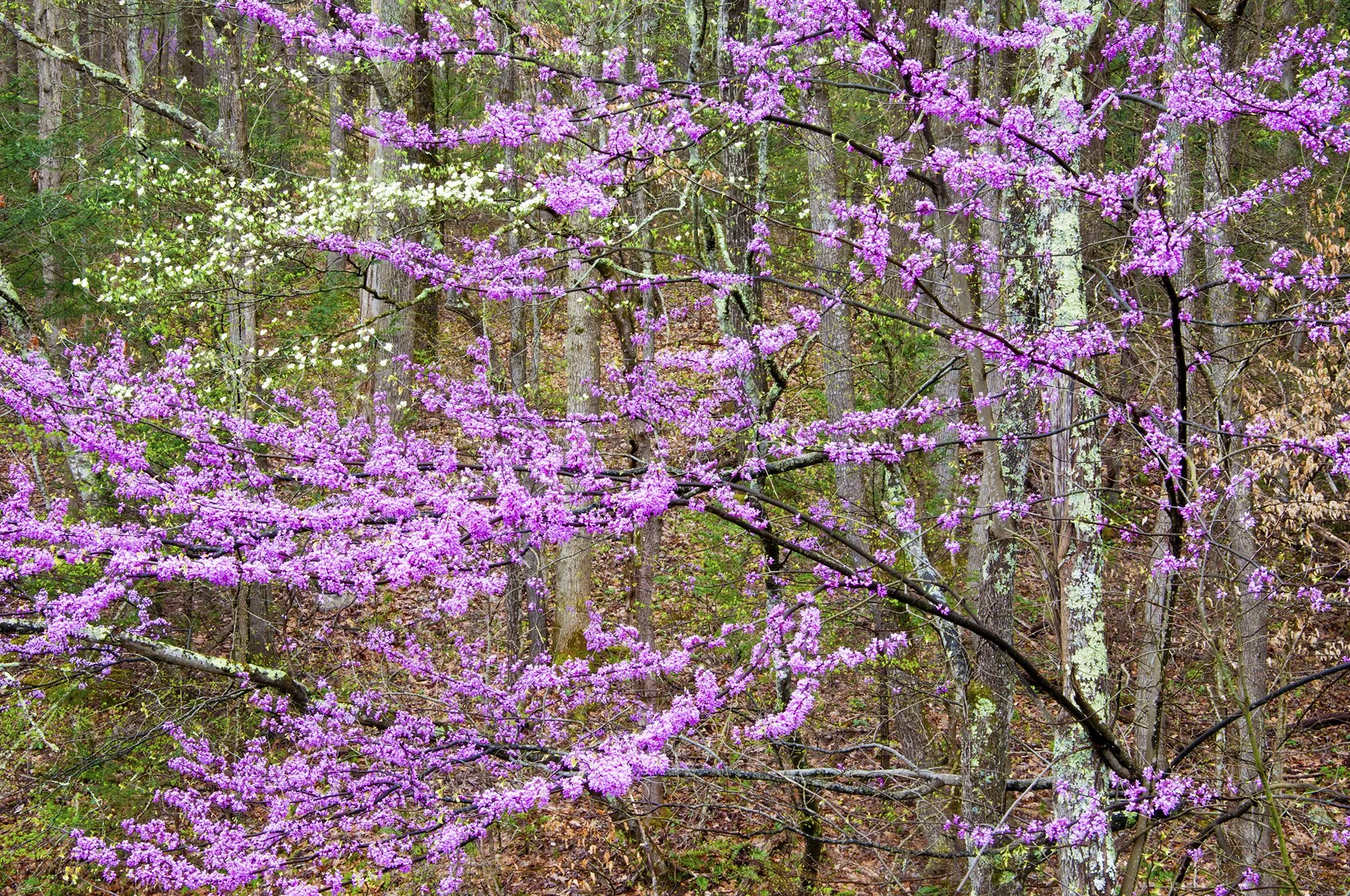
The hills and high mountains of Tennessee hold the most flowery forest in North America: redbuds, dogwoods, sourwoods, and tulip trees blooming over a prolonged spring. Thick with mosses, a capillary lace of streams, the forests gave a wandering child a regard that seemed to preexist even that of her human family.
If the zealous scientific methods and modernist tastes of our community distanced us from the old Tennessee cultures, they did not shield us from the slow effects of the land itself, the hills and high mountains that hold the most flowery forest in North America: redbuds and dogwoods, sourwoods, and tulip trees blooming over a prolonged spring. Thick with mosses, a capillary lace of streams, and snakes shedding papery skins, the forest of east Tennessee gave a wandering child a regard that seemed to preexist even that of her human family. But in those early, postwar years, the living rooms, patios, and lawns of Atom City itself, though immensely historic, were too new to actually hold any history, any layers of time or traditional customs. In that liminal atmosphere I had the sense that we had all risen up out of the ground overnight, like mushrooms after a hard rain.
•
Perhaps that is why I especially loved to get into my father's blue car several times a year and sit with my two brothers in the back seat for nine hours as we traveled south and into deep memory. When we arrived on the Callahan land in Tuscaloosa County, we walked with great-uncles who spoke in a familial way to paw-paw trees and animals. We walked a red field where my great-grandmother and grandmother had each planted seeds, my grandmother Frances dropping kernels in a row so straight that her father claimed she was the best corn planter in the county. "Better than any of my boys," he boasted. My grandmother was proud of that, and recalled her father's praise into her nineties. In red-clay Alabama we sat in parlors, not living rooms, and listened as our grandmother and her twelve siblings shared countless stories. Many about their mother, Nancy Augusta Speed, a redhead and writer of romantic fiction, a mother then undergoing the final stages of beatification, and about their father, a tall newspaper editor "of strong opinions strongly held," who, when his lungs sickened from printer's ink, sold his beloved Eutaw Mirror and took up farming. "Learned most of it from farm journals and books," said his youngest boy, then newly elected to the State legislature.
On the Callahan porches and in the Callahan parlors, the basic building block of the universe had long ago been discovered and named: it was Talk, and its constituent elements included Mama and Papa, and, of course, God-almighty, who was before all building blocks and all universes, and did not approve of gambling, a point on which Albert "God-does-not-throw-dice" Einstein and the Callahans of Tuscaloosa saw eye-to-eye.
The Callahans were not an insular people, they set forth (one as far as Alaska to found and publish frontier newspapers), and engaged deeply with the world, but when they gathered together they liked to remind themselves who they were. When a very large family enjoys its saga, when segments are told and retold, with disputes over crucial details and with laughter rippling the circle, a listening child might get the idea that here is the center of the world. In those parlors, I often felt like a small boat on the sea of their beautiful sounds, Scots-Irish and African cadences met in the Southern new world, and I assumed those sounds were as constant, and as eternal as the sea.
•
The automobile route we took from Atom City to the center of the world ran south-southwest alongside the Tennessee River, taking Highway 27 through Spring City and Dayton (site of the Scopes Trial, which our mother, a fan of science, reviewed for us), then through Soddy-Daisy and the gap at Lookout Mountain. From the Cumberland Plateau, we descended into miles of cotton fields, where my younger brothers and I were watchful for the Burma Shave signs then dotted along Highway 11. Whenever a series appeared we sprang into action, chanting the verses. Many dealt with the romance and good things that happen to a smoothly shaven man ("It gave / McDonald / That needed charm / Hello Hollywood / Good-bye farm"), but the Burma Shave poets were also concerned with travelers staying alive on the road:
Angels
Who guard you
When you drive
Usually retire
At 65
—Burma Shave
We thrilled to those fractured couplets, to the lame verse itself, I'm afraid, and also to the sheer idea of fitting rhymes to the speed and scale of the highway. We felt the American cleverness in those red-and-white signs, were proud to be part of such a country, a witty country, with its poetry inked along the road. Are we there yet? Gondolas of coal, and cabooses flew by our windows, and my mother remembers a carful of children who pleaded with their father to stop at every alligator game park, faux-wigwam motel, and fireworks stand along the road. It must have been a nearly continuous pleading, for if the 1950s highways were slow, they did not lack for that sort of wonder.
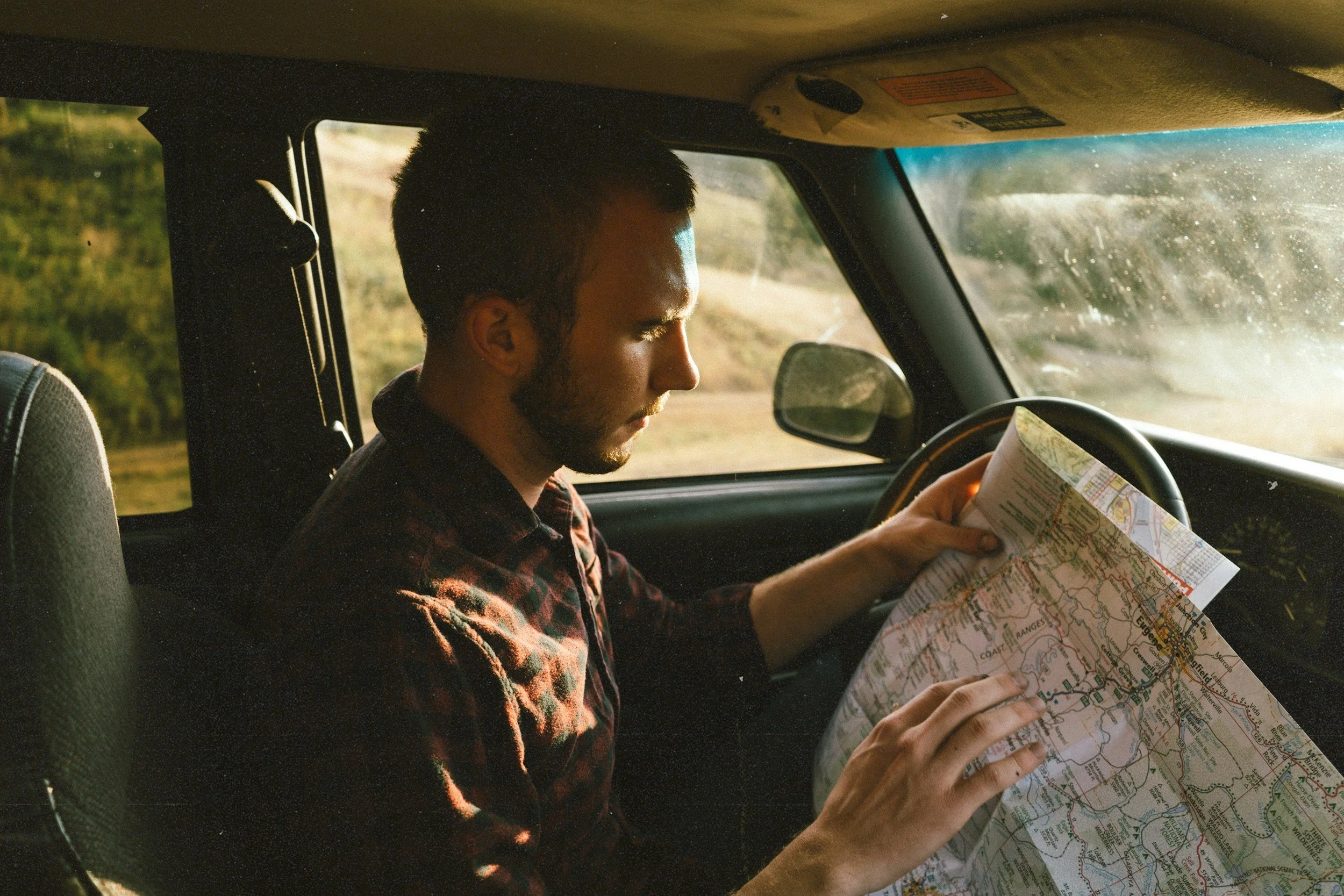
Lunch was always at a roadside restaurant called Ruby's Chicken-in-a-Basket, and no sooner were we settled in our booth than my father would spread his Texaco road map over the table. Was my mother impatient with him for reading the map during lunch, for tracing again the well-known route, and during a meal, which even on the road she felt should have a certain gracious tone? I do not remember, exactly, what she said. I only recall my father's determined reply: "I need to know where I am, Dear." And then his hand, deliberately tracing the red and blue lines, a tangle so like the circulatory system.
For all the time I knew him, my father liked maps, and I liked to look at them with him, beginning at that roadside lunch stop, hoping to puzzle out a connection between the clear lines marking our location and Ruby's itself, a place where the food came in red plastic baskets. Why didn't they just give us our lunch on plates? was one of my questions. And if it was going to be a basket, why not use a real straw basket or make the plastic into something that wasn't pretending to be something else, something all its own? And there was the question of our father's intense concern with location and safety, his cautiousness.
•
When I was young he spoke only rarely about his war, and then always in fragments, whose bone-clean form I have come to admire:
Normandy. After the landing at Utah Red Beach. At a fork in the road, and my father's infantry unit is moving into the interior. He is driving to set up communications lines along with several other men. A small convoy, my father in the last jeep. He and his pals — he loves these men — reviewed the map earlier, and agreed to go right at this fork. It's important. But the lead man makes a mistake, turns left, and the second jeep follows. My father tells his driver to stop, urgently signals his pals by walkie-talkie, waits at the fork for them to return. And then, out of sight, gunfire. "An ambush," the brief story ended. Unlike the stories in Alabama, our father's short short story was not meant to make us laugh, or remember fondly, and there was no satisfied ending such as "And so they did dig that well, and Mama and Papa used that water all their long lives."
In 1954 at the Chicken-in-a-Basket on Highway 11, I did not yet understand my father's wish to examine the map again, to review each detail. Later I would begin to know how war steals some things from people, and gives them other things. And now I might say that my father's scrutinizing of maps, his touching them, folding them up and tucking them in the sun visor, his getting them down and looking at them again was less a way to gauge a route, a route that he knew by heart, than it was a way to review the mystery of survival, to touch its creases as though touching an amulet.
After lunch, our father would fold up his map and tuck it into the felt visor over the driver’s seat until we pulled into the filling station on the outskirts of Birmingham. Are we there yet? We had arrived when we saw the neon “Moon Winx” motel sign, a heart-stopping piece of American road art: a double-sided, taxicab-yellow, crescent moon extravaganza, with a man-in-the-moon face on each side, and a blue eye that winked. And with a sensational misspelling. (Did I love the “x” because it showed that adults could play with words and spelling, at least in neon?) Two miles beyond the winking moon, the Chrysler's tires made a crunching sound on the bed of river pebbles on the Callahan drive. In morning light, the pebbles would be the colors of salmon and pearls, and the smooth stones from the bed of the Tombigbee River, closed around our young bare feet like cool pockets.
And yet this charmed place was the very place that my mother had left at twenty, feeling some of the diffuse stifle that any young person may feel in any enmeshed society, but also wondering, as later told me: "What kind of life could I have had there, where I didn't agree with the deep South’s treatment of African Americans and women." After graduate school in Chicago, my mother wrote for the Foote, Cone & Belding agency, listened to jazz, said yes to my father’s proposal at Wrigley Field, and made curtains out of surplus parachutes for their first home together. Although she often called the adult me to say, "Let's go home," meaning a trip together to Tuscaloosa, and although the accent and manners of her first home were suffused in her person, my mother had little tristesse for a lost place or past. She was the possessor of a mind so open and generally with-it that I was lulled occasionally into thinking her my complete contemporary, and might shock her by some phrase beneath the more dignified norms of her generation.
•
As my mother and father leaned so bravely into the post-WWII decade, it was easy to feel us all going faster, like the agitated electrons in the Atoms for Peace Museum movie that were "preparing," the narrator explained, "to jump into another orbit." Neither my mother nor my father could afford to look back. It was their child, saturated from infancy in a modernist world, who was drawn to gazing at vanishing traditions, old ways, and vacated shadows. Taking the techno-futurism of my hometown as the norm, I was riveted by the familial rooms in a rural culture, by their kerosene lamps, dark wood cabinets, and antique sideboards, by shelves of sewing patterns, and a kinship system that included the extended family. And also by the astounding knowledge that I belonged, simply by virtue of being the daughter of the daughter of Frances Webb Callahan Watkins.
But try as I might, I, who had touched the silver Van de Graaff generator, could never fully enter into the world of buggies, corn planting, and circuit preachers, and by age ten I had also begun to realize that there were no buggies on their lands anymore, nor any circuit preachers making rounds. My elders were conjuring another world, with words. Meanwhile, in Oak Ridge, my friend Arthur Snell and I were planning to build a rocket ship, for which thought we could find most of the parts we might need.

“Could our species come to live on the earth as well as the Pearly Eye? Naturally, it seems unlikely: one of us a short-lived creature with wings…”
— from “At the Pavilion”